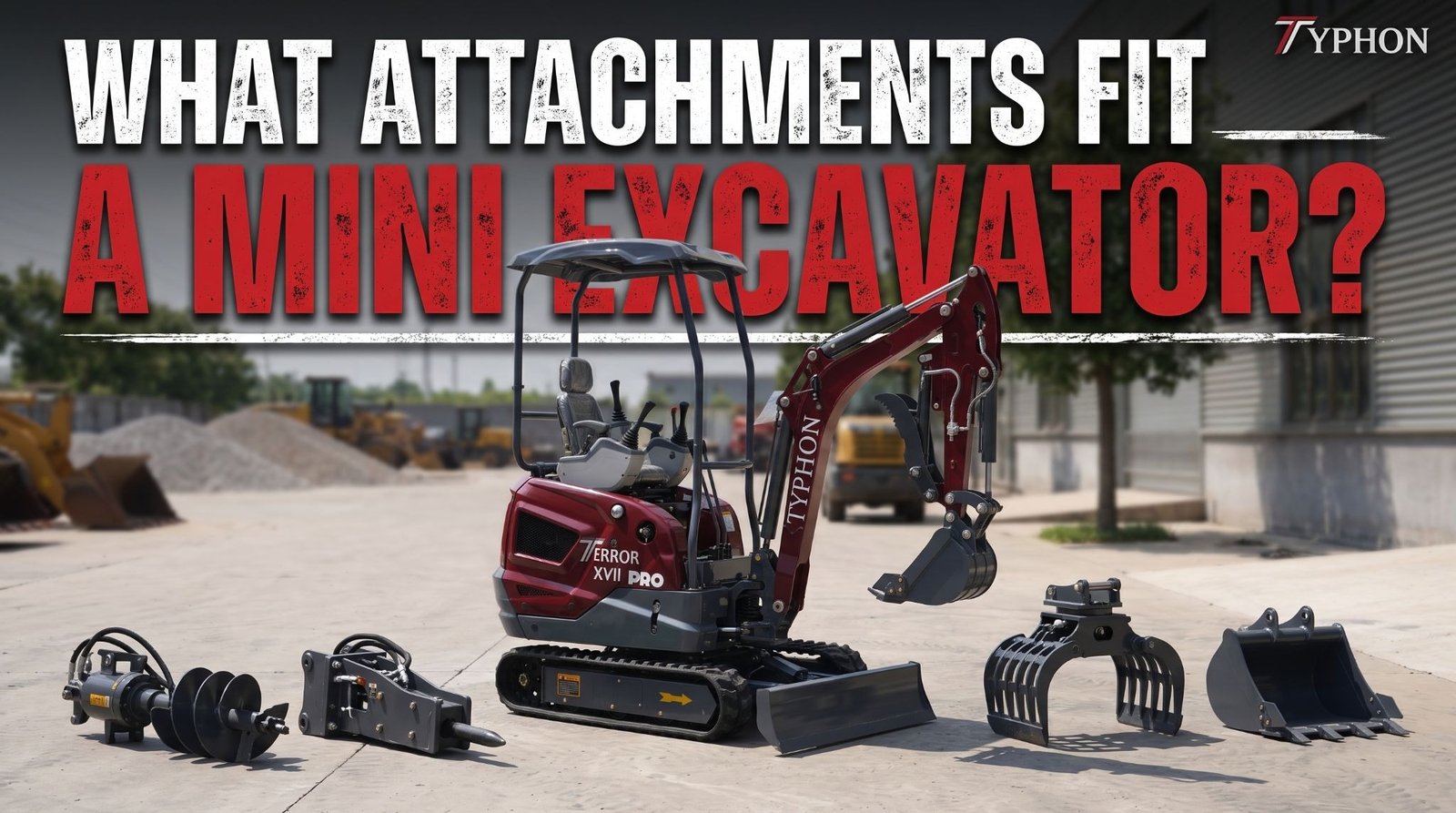
Your mini excavator may have been purchased for digging, but that’s only the beginning of what it can do. As projects become more varied, you may find yourself needing to remove stumps, drill post holes, grade driveways, break concrete, or move heavy materials. With only a standard bucket, those tasks often require renting additional equipment or hiring outside contractors, adding time and expense to every job. The good news is that the same mini excavator can take on many of these applications with the right attachments. Equipping your machine for the work you do most transforms it from a dedicated digging machine into a versatile tool that can tackle a much wider range of projects while helping you get more value from your investment.
That’s the real power of a mini excavator: it’s a tool carrier as much as a digger, and the attachments you fit determine how many jobs it can close. But not every tool bolts on and works. Coupler style, hydraulic capacity, and machine weight all decide what your specific unit can actually run. This post walks you through the attachments that fit a compact excavator, how to confirm compatibility with your machine, and how to choose the tools that turn one investment into a fleet of capabilities.
The everyday attachments most owners run first
On almost every mini excavator jobsite, you’ll find a few attachments that operators rely on time and time again. These essential tools handle the majority of everyday tasks, increase the machine’s versatility, and often deliver the fastest return on investment. Starting with these attachments gives your mini excavator the flexibility to tackle a wider range of jobs without adding another machine.
Buckets for digging, grading, and cleanup
The bucket is where it starts, and most owners quickly learn one isn’t enough. A narrow trenching bucket cuts tight, deep lines for utilities and drainage, while a wider digging bucket moves more soil per pass on general excavation. Match the width to the work, and every scoop counts.
Then there’s the grading bucket, also known as a ditch-cleaning bucket. Its wide, flat design, typically without teeth, makes it ideal for smoothing surfaces, shaping slopes, cleaning ditches, and finishing grades with precision. Before selecting a bucket, verify your machine’s maximum digging depth, as it determines the range of excavation work your mini excavator can handle. A deeper digging reach expands your capabilities for drainage trenches, utility installation, and foundation work. With a trenching bucket, a general-purpose bucket, and a grading bucket in your lineup, your mini excavator is equipped to handle most everyday earthmoving and site preparation tasks.
Augers for fast, clean holes
An auger turns your excavator into a post-hole and planting machine, boring clean, consistent holes far faster than any hand tool. Fence lines, deck footings, sign posts, and tree planting all go quickly once the auger drive is mounted and the right bit is fitted.
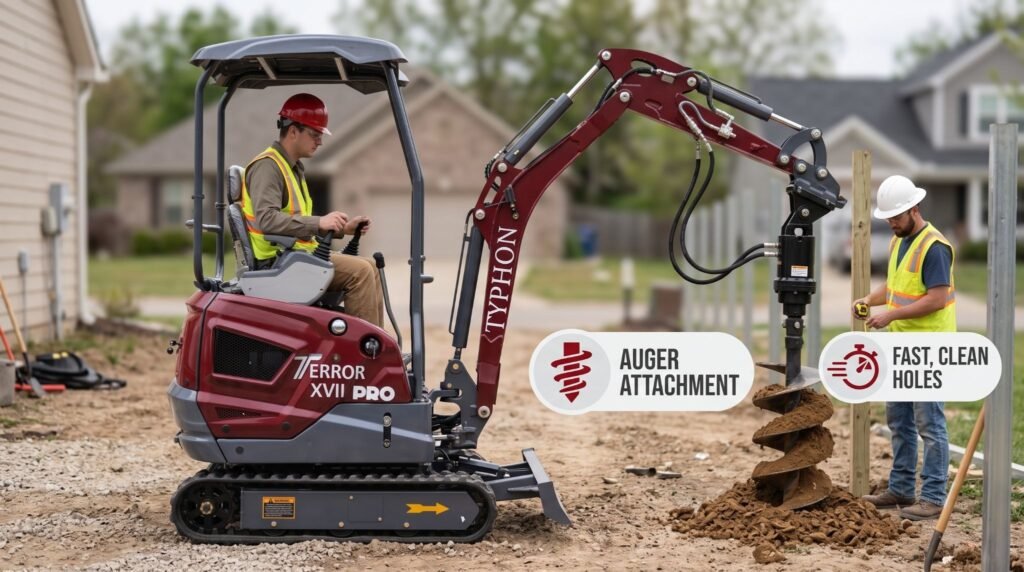
Bit diameter is the detail to get right. Augers accept different-sized bits, so you can bore a six-inch hole for a fence post or a much wider one for a structural footing. Because an auger runs on the machine’s hydraulics, checking your hydraulic flow rate against the auger drive’s requirement is what confirms it’ll spin with real power rather than stalling under load.
Thumbs and grapples for grabbing and sorting
A hydraulic thumb is one of the most valuable attachments you can add to a mini excavator. Working alongside the bucket, it allows the machine to securely grip, lift, and place irregular materials such as rocks, logs, tree stumps, brush, and demolition debris. This added control transforms the excavator from a machine built primarily for digging into a versatile tool for material handling, land clearing, and cleanup tasks.
Grapples take that a step further, with two jaws built specifically for grabbing and sorting demolition debris, brush, and scrap. For land clearing and cleanup, a thumb or grapple transforms how much a single operator can accomplish.
Takeaway: a set of task-specific buckets, an auger, and a thumb or grapple cover the bulk of everyday mini excavator work and are the smartest first attachments to own.
Heavy-hitting tools that expand what the machine tackles
Some jobs call for more than digging and grabbing. When there’s concrete to break, brush to clear, or hard ground to rip, a specialized attachment turns a mid-size project into an afternoon’s work. These tools cost more and demand more from the machine, but they open doors to work you’d otherwise turn down.
Breakers for concrete and rock
A hydraulic breaker, also called a hydraulic hammer, replaces the bucket to break through concrete, asphalt, and rock with powerful impacts. It’s ideal for demolition jobs such as removing slabs, breaking foundations, and clearing hard surfaces, giving your mini excavator far greater versatility.
Breakers are hydraulically demanding, so this is where machine matching matters most. The breaker’s flow and pressure needs have to align with what your excavator delivers, and its size and impact energy should suit your machine’s weight class. Undersize the machine and the breaker starves; oversize the breaker and you risk straining the unit.
Mulchers, brush cutters, and rippers
For overgrown lots and land clearing, a brush cutter or mulcher clears vegetation fast, chewing through brush and small trees that would take a crew hours by hand. Land-clearing contractors lean on these tools to turn tangled ground into a workable site in a fraction of the time.
A ripper attachment uses a single heavy-duty tooth to break through compacted soil, frozen ground, roots, and soft rock that a standard bucket struggles to penetrate. Before using hydraulic-powered attachments, check that your mini excavator provides enough auxiliary hydraulic flow, especially for high-demand tools like mulchers. Matching the attachment to your machine’s hydraulic capacity ensures reliable performance and helps you get the most from your equipment.
Compaction plates for backfill and trenches
Once a trench is dug and utilities are installed, the ground needs proper compaction. A hydraulic compaction plate attaches to the mini excavator and vibrates soil directly inside the trench, allowing the same machine to handle both excavation and backfilling. This improves efficiency, reduces the need for additional equipment, and helps create a stable, well-compacted surface.
This attachment shines on utility and drainage work, where digging and backfilling are two halves of the same job. Compacting from the seat also keeps the operator safely out of the trench.
Takeaway: breakers, mulchers, rippers, and compaction plates extend a mini excavator into demolition, land clearing, and finishing work, provided the tool’s hydraulic and weight demands match your machine.
What actually determines whether an attachment fits
Here’s the mistake that burns owners: assuming any attachment labeled “mini excavator” will bolt onto theirs. It won’t. Compatibility comes down to a few hard specifications, and checking them before you buy saves money and downtime. Three factors decide the fit almost every time.
Coupler type and pin size
Attachments connect through the coupler at the end of the arm, and this connection has to match. Some machines use a direct pin-on mount, while many run a quick coupler that lets you swap tools in seconds without leaving the cab. The two aren’t interchangeable without the right setup.
Even with a matching coupler, the mounting dimensions have to line up. Confirm the bucket pin size, pin spacing, and the width between the ears against the attachment’s specs, because a coupler that’s close but not exact simply won’t seat. Getting the mounting interface right is the first and most fundamental compatibility check.
Hydraulic capacity for powered tools
Non-powered attachments, such as buckets and rippers, only require the correct mounting system. Hydraulic attachments like augers, breakers, thumbs, grapples, and mulchers rely on your mini excavator’s auxiliary hydraulic system to operate. Before adding one, make sure your machine provides the required hydraulic flow and pressure, as this is one of the most common compatibility issues between excavators and attachments.
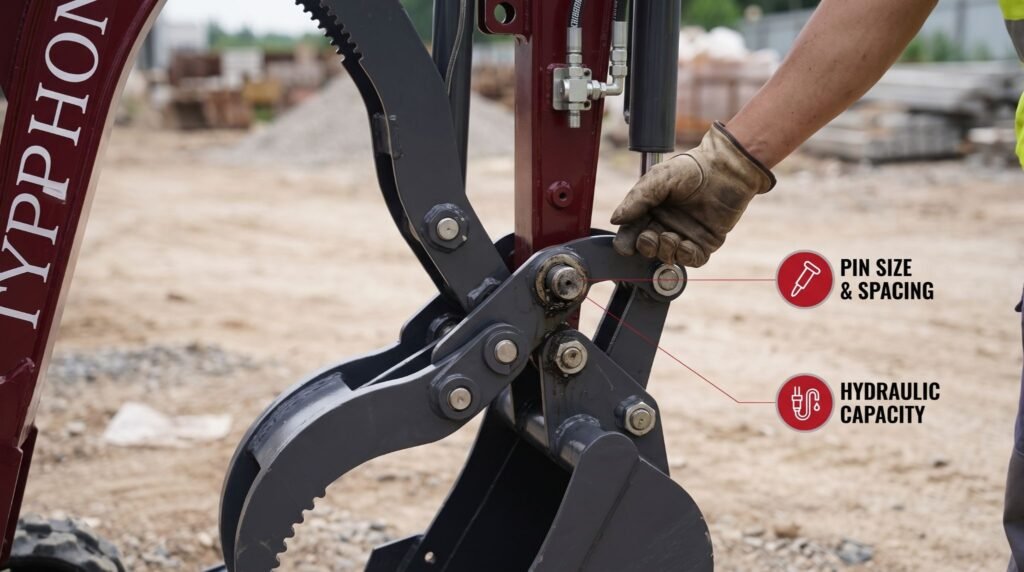
Two specifications matter most: hydraulic flow, measured in gallons or liters per minute, and hydraulic pressure. Compare the attachment’s requirements with your machine’s auxiliary hydraulic output, and confirm it has the correct hydraulic circuit. Some attachments require a bi-directional circuit, while others operate with a single-acting line. If an attachment demands more hydraulic flow than your mini excavator can provide, it will perform poorly or may not operate at all, making this an essential compatibility check before purchasing.
Machine weight and size class
The last factor is raw match of scale. Mini excavators span a wide range, from roughly one-ton units up to eight tons and beyond, and attachments are built for specific weight classes. A breaker sized for a five-ton machine will overwhelm a one-ton unit.
Fitting an oversized attachment risks instability, poor performance, and premature wear on your machine. Fitting an undersized one wastes the machine’s capability. Check the manufacturer’s recommended weight class for each attachment against your excavator’s operating weight, and stay within it.
Takeaway: Attachment compatibility depends on three key factors: the correct coupler and pin configuration, sufficient hydraulic flow and pressure, and a weight class that matches your mini excavator. Verifying all three before purchasing helps ensure safe operation, reliable performance, and long-term durability.
Frequently asked questions
Do all attachments fit every mini excavator?
No. An attachment fits only when three things line up: the coupler and pin dimensions match your machine’s mount, your auxiliary hydraulics supply enough flow and pressure for powered tools, and the attachment is built for your machine’s weight class. A tool labeled “mini excavator” won’t necessarily fit yours, so always check these specifications against your specific make and model before buying or renting.
What are the most useful mini excavator attachments to own?
For most owners, the highest-value tools are a set of task-specific buckets (trenching, digging, and grading), a hydraulic thumb for grabbing and placing material, and an auger for boring holes. These cover the bulk of everyday work and pay for themselves fastest. Specialty tools like breakers or mulchers are worth owning only when your jobs demand them regularly; otherwise renting makes more sense.
Can I use a quick coupler to switch attachments faster?
Yes. A quick coupler lets you swap attachments in seconds, often without leaving the cab, which is a major time-saver on jobs that require frequent tool changes. Just confirm that your attachments and coupler share a compatible mounting system, since a quick coupler and a pin-on attachment won’t connect without the correct setup or an adapter.
Conclusion
Every attachment changes what your mini excavator is capable of, but not every attachment belongs in every fleet. The best setup is built around the work you perform most often, whether that’s trenching, demolition, grading, material handling, or land clearing. Before adding a new tool, verify that it matches your machine’s coupler, hydraulic specifications, and operating weight to avoid costly compatibility issues. With the right attachments in your lineup, one mini excavator can replace multiple specialized machines and take on a wider variety of jobs without adding unnecessary equipment to your fleet.