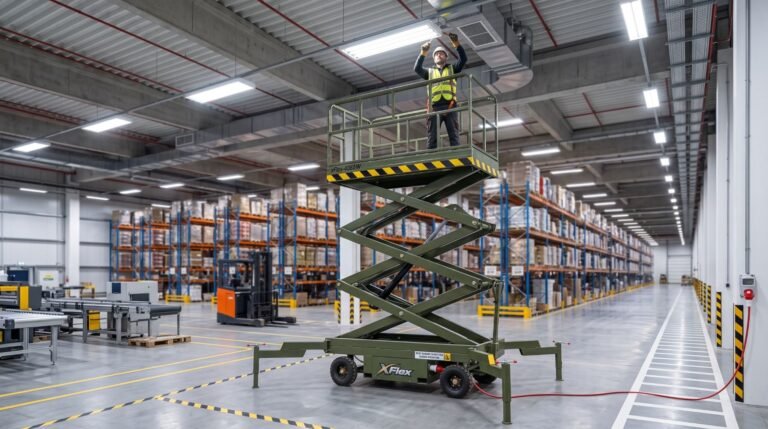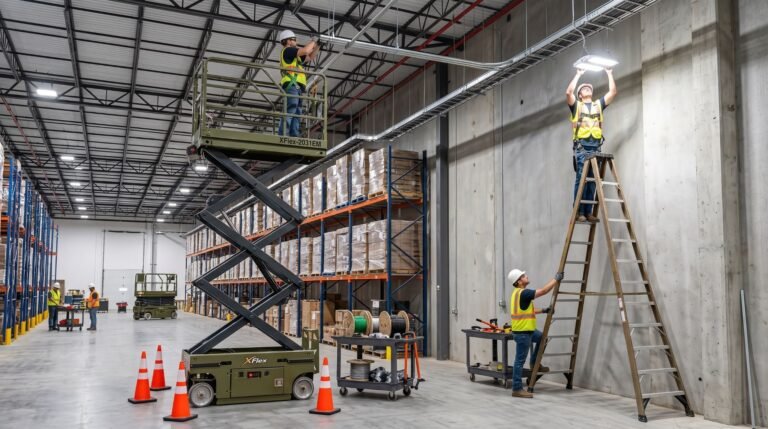
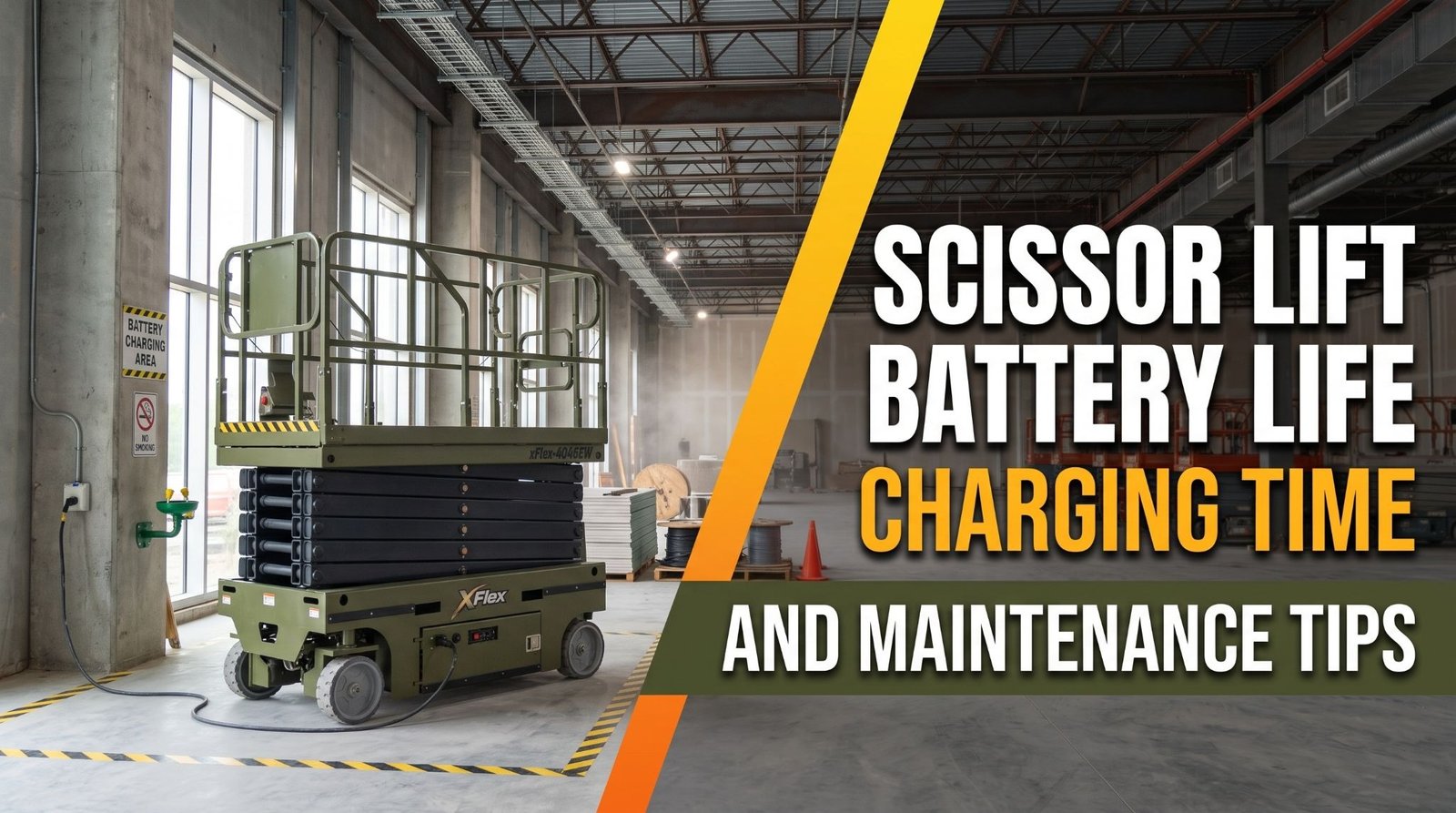
Three hours into a night shift at a new hospital wing, an electrical crew is pulling cable through ceiling trays from four electric scissor lifts. One machine starts beeping a low-battery warning, and minutes later its lift function cuts out. The platform can still lower, but it won’t rise again. A second lift slows noticeably on the drive. By midnight, two of the four machines are parked, and the crew is waiting on chargers instead of installing cable.
The maintenance log shows the cause. One lift had been plugged in for only two hours the previous afternoon. The other had several cells with low electrolyte that hadn’t been watered in nearly three weeks. Neither machine was defective, and both failures were preventable.
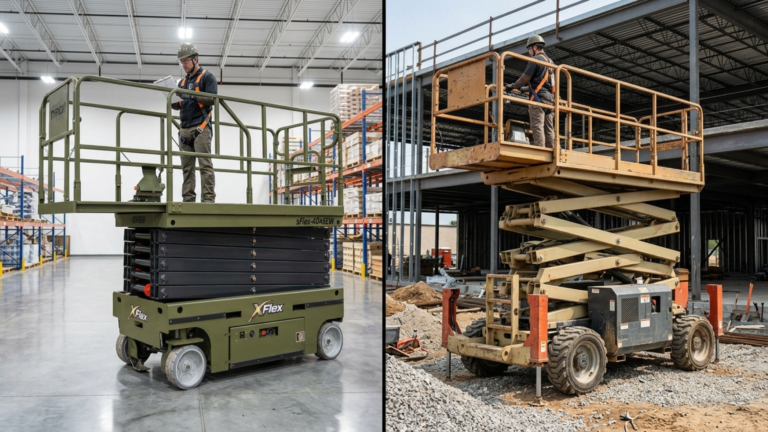
Electric scissor lifts support indoor construction, warehouse maintenance, facility repairs, and many other elevated tasks. Their batteries power drive, lift, steering, and controls, so battery health directly shapes daily productivity. Fleet managers, rental coordinators, and operators who want dependable uptime need to understand what drives battery runtime, how different battery types differ in care and charging, how to build sound daily routines, and how to service batteries safely. The lift manufacturer’s operator’s manual, the battery and charger documentation, and applicable regulations remain the primary reference for every machine.
Factors That Affect Scissor Lift Battery Life
Runtime depends on how much energy the battery stores and how quickly the machine uses it. Battery capacity varies by machine size and system voltage, and larger or higher-voltage packs generally store more energy. Not all of that energy should be used, though. Deep-cycle lead-acid batteries last longer when they aren’t regularly discharged to very low levels, and many machines include a low-voltage cutout that disables the lift function before the battery reaches a damaging state. Planning around a reasonable usable portion of rated capacity helps protect the battery and sets more realistic runtime expectations.
Scissor lifts don’t draw steady current across a shift. They pull heavily when lifting, moderately when driving, and very little while the operator works at height. The average draw across the whole shift determines runtime, and that average varies considerably between jobs. The same machine can last a full shift on one job and run short on the next depending on how often it lifts and how far it travels.
Several conditions raise energy consumption beyond what a light-duty cycle would require. Frequent lift and lower cycles with heavy platform loads, long drive distances, rough floors, ramps, and grades within the machine’s permitted range all increase draw. Cold temperatures reduce available capacity, as do aging batteries that no longer hold their original charge. Accessories such as work lights or onboard power outlets add to the load as well. Temperature deserves particular attention because a lead-acid battery in cold conditions can deliver meaningfully less capacity than the same battery at room temperature, and the effect grows as temperatures fall further. Lifts working in unheated buildings or cold storage during winter often run short of their summer runtime as a result.
Key takeaway: Runtime depends on usable capacity, average current draw, workload, temperature, and battery age, so estimate it from your actual duty cycle rather than a published maximum.
Understanding Different Battery Types
Chemistry determines how a battery is charged, how often it needs attention, and how long it lasts. Electric scissor lifts generally use one of three types, and each has its own maintenance needs. Always follow the instructions for the exact battery installed in your lift.
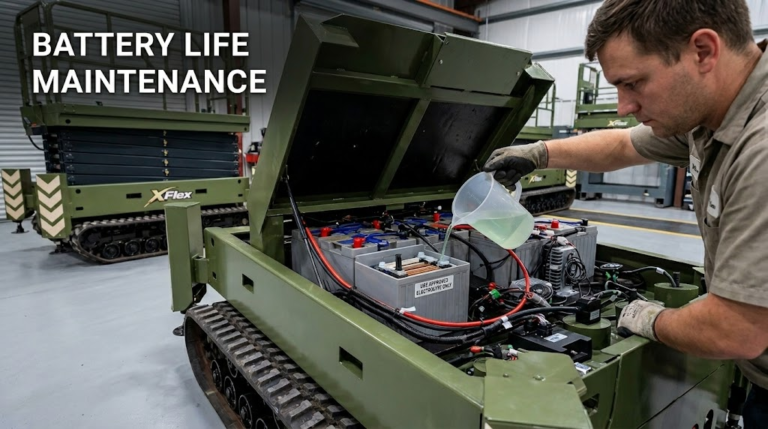
Flooded lead-acid batteries remain common because they’re durable and economical. Their plates sit in liquid electrolyte, which loses water during charging. They require regular electrolyte checks and watering with distilled or approved water, charging in a ventilated area since they release hydrogen gas during charging, periodic equalization charges when the manufacturer specifies them to balance cells and reduce sulfation, and cleaning to remove acid residue from battery tops and trays. With good care, deep-cycle flooded batteries can deliver a substantial number of cycles before capacity declines significantly.
Sealed batteries, including absorbed glass mat and gel designs, are valve-regulated and don’t need watering. That reduces routine maintenance and the risk of acid spills. They still need the correct charging profile, though. Charging a sealed battery with a flooded-battery profile can overcharge it, dry it out, and shorten its life. Confirm that the charger is set for the installed battery type before use.
Lithium-ion systems, often lithium iron phosphate, are increasingly offered on new scissor lifts. A battery management system monitors cell voltage, temperature, and current, and protects the pack from damaging conditions. Lithium-ion batteries generally tolerate opportunity charging during breaks without harm, charge faster depending on charger output and management system limits, require no watering or equalization, and can reach a larger number of cycles under suitable conditions. Most can’t be charged below freezing unless the pack includes heating, and the management system may block charging in cold conditions.
Battery weight often contributes to a scissor lift’s stability, since the batteries sit low in the chassis. Never substitute a lighter battery or convert chemistries unless the lift manufacturer approves that replacement. Approved conversion kits account for weight, mounting, charger compatibility, and control software.
Key takeaway: Flooded, sealed, and lithium-ion batteries each require different charging and care, so follow the documentation for the installed battery and never substitute a lighter or unapproved battery.
What Determines Scissor Lift Charging Time
Charging time is the second half of uptime planning. Several factors combine to set it, including battery capacity, remaining state of charge when charging begins, charger output current, battery chemistry and charging profile, battery and ambient temperature, and battery condition and age.
A practical way to estimate charging time is to consider the amp-hours that need to be replaced, the charger’s output, and an allowance for charging losses and the finishing stage that lead-acid batteries require. The bulk of the energy goes in relatively quickly, but lead-acid chargers taper their output as the battery approaches full charge. The final portion of a full cycle can take longer than expected, and unplugging a lift when it looks nearly charged often leaves it well short of full capacity.
Lithium-ion packs often charge considerably faster than lead-acid for the same capacity, depending on charger output and the limits set by the battery management system. The machine and battery documentation provide the expected charging range for each configuration, and that range is more reliable than estimating from voltage alone. Battery voltage rises during charging and sags under load, so a reading taken at the wrong moment can give a misleading picture. Use the machine’s battery indicator, the charger’s status lights, or management system data on lithium-ion packs. On flooded batteries, a hydrometer reading of specific gravity after charging gives the most reliable state-of-charge check.
Temperature also affects charging speed. Cold batteries accept charge more slowly, and many chargers adjust their output for temperature. Very hot batteries can charge poorly and age faster. Charge in a location within the temperature range the battery manufacturer specifies.
Key takeaway: Charging time depends on amp-hours replaced, charger output, chemistry, and temperature, so use the approved charger and the machine’s documentation rather than judging charge from voltage alone.
Daily Battery Inspection and Charging Practices
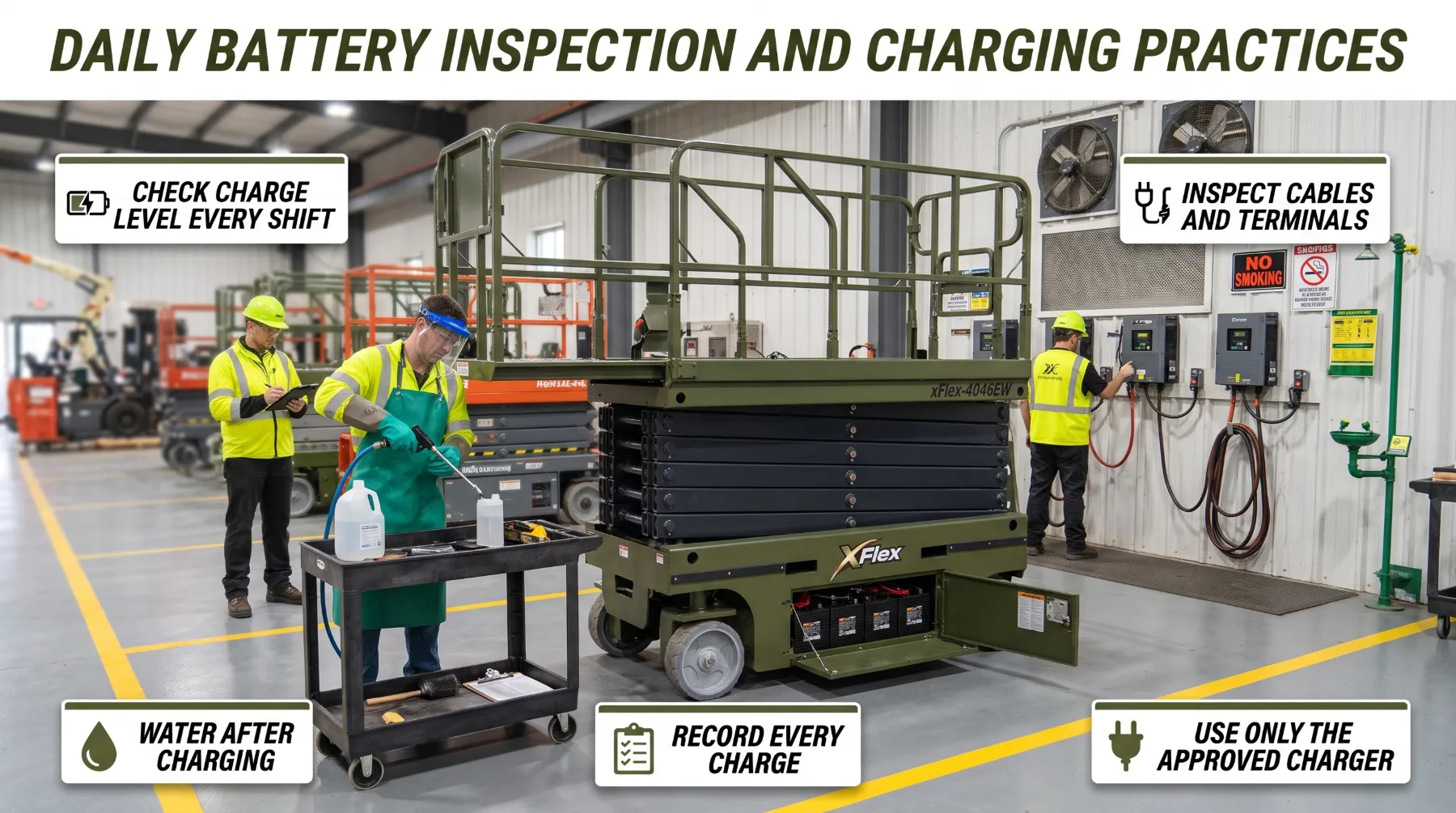
Consistent routines prevent most battery-related downtime. A short daily check combined with disciplined charging keeps each lift ready for the next shift. Every pre-operation inspection should cover the battery charge indicator, cables for cracks and heat damage, terminals for tightness and corrosion, battery hold-downs, battery tops for cleanliness and dryness, and the charger cord and charging port. Any damaged cable, loose terminal, or corrosion should be reported before the lift goes to work.
For flooded batteries, timing matters when adding water. Electrolyte levels should be checked at the interval the manufacturer specifies, which is often weekly for lifts in daily use. Water should be added after charging, since electrolyte expands as the battery charges. If plates are exposed before charging, add only enough water to cover them, then complete the top-off after the charge. Distilled or manufacturer-approved water is the only suitable choice, since tap water can contain minerals that shorten battery life. Overfilling spills acid and corrodes trays and frames.
Charging habits shape battery life more than almost any other factor. Plugging in at the end of every shift, using only the charger approved for the battery type and voltage, and allowing lead-acid batteries to complete the full charge cycle are the three most important habits a fleet can establish. Equalization charges should be run only on the schedule the manufacturer specifies. Lithium-ion batteries tolerate opportunity charging, so lunch-break charging can extend runtime on demanding days. Keeping charging records helps fleets with multiple lifts across shifts by showing which machines run short, which operators skip charging, and which batteries are aging.
Key takeaway: Inspect cables, terminals, and charge level every shift, water flooded batteries after charging with distilled water, complete full charge cycles on lead-acid packs, and record charging activity across the fleet.
Recognizing Signs of Battery Wear
Batteries age gradually, and the early signs are easy to miss. Catching them early allows planned replacements instead of losing machines mid-shift. The most noticeable sign is a shorter runtime between charges, but other indicators include charging that takes much longer than normal or never completes, charger fault codes or repeated restarts, batteries or cables that feel unusually hot after charging or use, repeated low-voltage warnings or lift cutouts early in the shift, swollen or cracked battery cases, heavy corrosion that returns quickly after cleaning, and flooded batteries that need water far more often than others.
Poor runtime doesn’t always mean a bad battery. Heavy workloads, cold temperatures, incomplete charging, a faulty charger, or an electrical fault in the machine can produce the same symptoms. Testing identifies the real cause. For flooded batteries, a qualified technician can measure specific gravity in each cell after a full charge and perform a load test to reveal whether the battery can hold voltage under demand. Charger diagnostics confirm whether the charger delivers its rated output. On lithium-ion packs, management system data and fault codes show cell balance, temperature history, and capacity.
In a multi-battery pack, one weak battery drags the whole set down. Manufacturers often recommend replacing batteries as a matched set rather than mixing new and old units. Use the battery type, capacity, and weight the lift manufacturer specifies.
Key takeaway: Shorter runtime, slow charging, heat, case damage, and frequent watering signal wear, so test the batteries and charger to confirm the cause before replacing anything.
Storage and Long-Term Battery Care
Idle periods can damage batteries as surely as hard use. A scissor lift parked for a season without care may return with batteries that won’t hold a charge. Lead-acid batteries should be fully charged before storage, and electrolyte levels on flooded batteries should be checked and corrected after charging. Battery tops, terminals, and trays should be cleaned, and the battery disconnect switch should be turned off if fitted, to stop parasitic drain from controls. Storing the lift indoors or under cover in a dry location protects both the batteries and the machine.
Lithium-ion packs often call for a partial rather than full charge level during storage, so follow the manufacturer’s guidance for the specific battery installed.
Lead-acid batteries self-discharge slowly, and deep discharge allows sulfate crystals to harden on the plates. Stored batteries should be checked at the interval the manufacturer specifies and recharged when needed. Some chargers offer a maintenance mode that keeps batteries topped up safely. During operation, use the safety features provided by the lift, such as battery charge indicators, low-voltage warnings, emergency stop controls, and battery protection systems, where equipped. Follow the manufacturer’s operating procedures and avoid using the lift when the battery charge is critically low. Temperature matters during storage as well. Heat accelerates aging, so avoid storing lifts in hot sheds or direct summer sun. A fully charged lead-acid battery resists freezing, but a discharged one can freeze at temperatures well within a normal winter, which can crack cases and destroy plates. Keeping stored batteries charged is the best protection against both extremes.
Before the machine goes back to work, inspect the battery compartment for corrosion, moisture, and rodent damage. Charge the batteries fully, check electrolyte on flooded units, and complete a full function test to confirm that runtime meets expectations during the first shift back.
Key takeaway: Charge before storage, disconnect parasitic loads, store in a dry and temperature-controlled location, recharge on schedule, and inspect thoroughly before returning the lift to service.
Safe Inspection, Leak Checks, and Lockout
Batteries and hydraulics both store energy on a scissor lift. Lead-acid batteries contain corrosive acid and release hydrogen gas during charging. The hydraulic system holds the platform up on trapped oil. Safe practice addresses both.
When servicing lead-acid batteries, wear safety glasses or a face shield, chemical-resistant gloves, and an apron. Remove rings and watches, and use insulated tools, since a dropped wrench across terminals can cause severe burns or an explosion. When disconnecting batteries, follow the manufacturer’s sequence, typically removing the negative cable first and reconnecting it last.
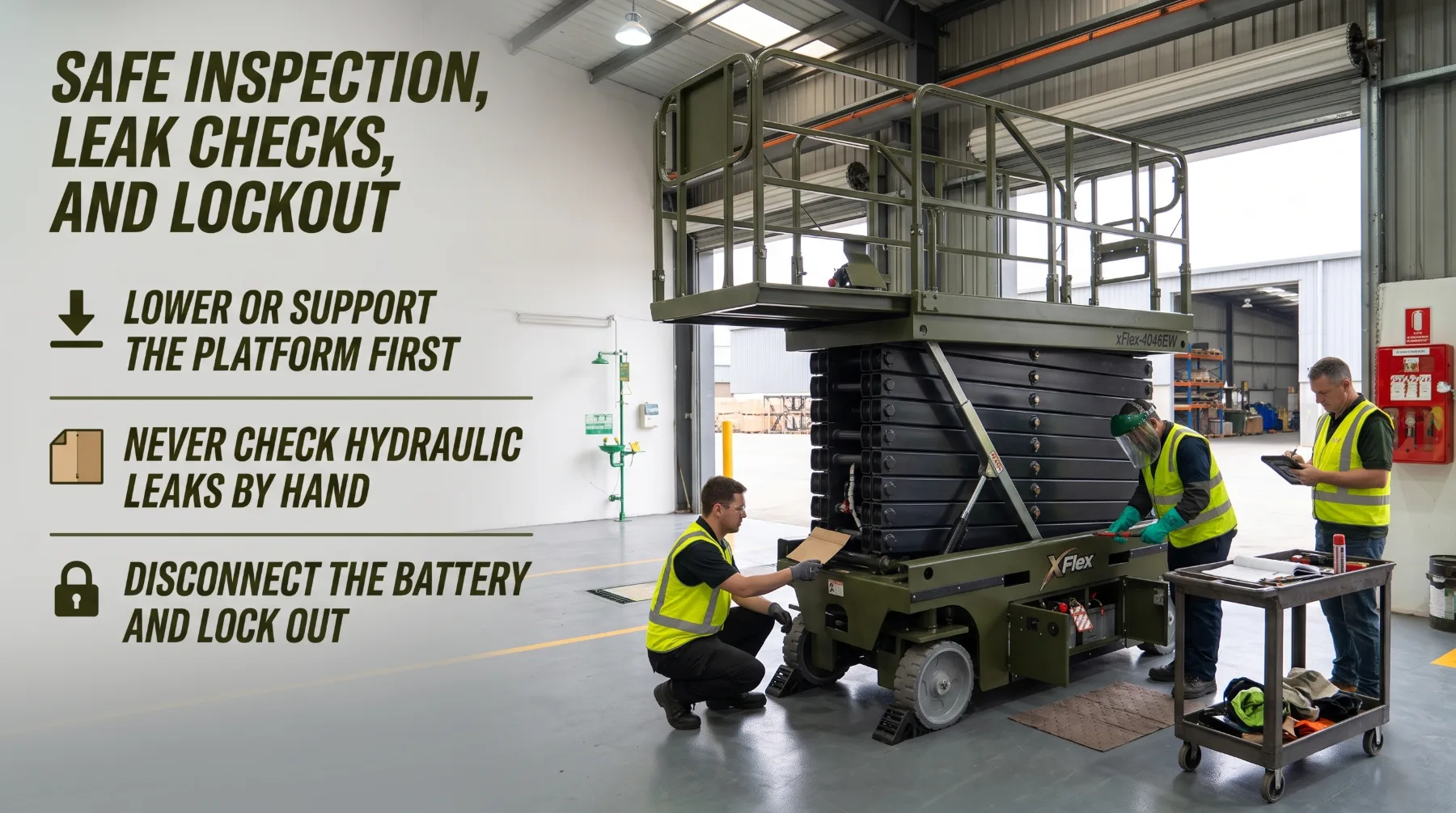
Hydraulic hoses run to the lift cylinder, steering, and brake circuits. Never use your hand to search for a hydraulic leak. Fluid escaping through a pinhole under pressure can penetrate skin and cause an injection injury. The wound may look like a minor puncture at first, but it’s a medical emergency that requires immediate surgical treatment. Hold a piece of cardboard or wood near the suspected hose, fitting, or cylinder. Wear gloves and eye protection, and keep your face and body out of line with the leak point. If anyone is struck by escaping hydraulic fluid, get emergency medical care at once and tell medical staff it’s a hydraulic injection injury.
Before any inspection beyond the pre-shift check, and before every repair, follow a complete lockout sequence. Park on firm, level ground away from traffic and edges. Lower the platform fully to the stowed position. If the platform must be raised for access, engage the manufacturer’s maintenance safety arm or support exactly as instructed. Turn the key off, remove it, and press the emergency stop. Chock the wheels where required. Turn off the battery disconnect switch or disconnect the battery as the manual directs. Relieve hydraulic pressure as the manufacturer instructs. Apply your personal lock and tag, then verify isolation before starting work. Never work beneath a raised platform or scissor stack held only by hydraulics, and never rely on improvised blocking. Leave charger repairs, electrical diagnosis, and hydraulic work to qualified technicians. Only trained, authorized operators should run the lift, in line with ANSI A92 standards and site rules.
Key takeaway: Wear proper protection around batteries, check hydraulic leaks with cardboard rather than your hands, and lower or support the platform, disconnect power, and lock out before any service.
Conclusion
Dependable scissor lift uptime starts with understanding the battery. Runtime depends on usable capacity, average current draw, temperature, and battery age. Charging time depends on how many amp-hours must be replaced, charger output, and chemistry. Flooded, sealed, and lithium-ion batteries each require their own care, and none should be replaced with an unapproved or lighter alternative.
Adding battery checks to every pre-shift inspection, setting a firm end-of-shift charging rule, and watering flooded batteries after charging all protect uptime. Tracking runtime and charging in a simple log lets wear show up early. Combined with safe battery handling, cardboard leak checks, and full lockout, those habits will keep your fleet delivering reliable performance shift after shift.
Frequently Asked Questions
How long can an electric scissor lift operate on one charge?
Runtime varies with battery capacity, machine model, workload, and temperature. Cold conditions and aging batteries shorten it further. Estimate runtime from your actual duty cycle and workload rather than relying on a published maximum, since the same machine can deliver very different runtimes from one job to the next.
How long does it take to charge a scissor lift battery?
Lead-acid packs commonly need many hours for a full charge, depending on capacity, depth of discharge, and charger output. Lithium-ion packs often charge in a shorter period with a suitable charger. Check the machine and battery documentation for the expected charging range for your specific configuration.
What is an early sign of battery deterioration?
A noticeable drop in runtime between charges is often the first sign. Slow charging, unusual heat, frequent watering, and repeated low-voltage warnings can also signal wear. Test the batteries and charger to confirm the cause, since workload, cold weather, or a charger fault can produce similar symptoms.