A scissor lift is one of the safest tools for working at height, but it only remains safe when used with complete attention. Most accidents do not occur because the machine fails or breaks down; instead, they happen because of a missed safety step, a rushed decision, or a failure to check for hidden hazards before going up. The encouraging news is that nearly every common scissor lift accident is preventable if you adopt the right habits and maintain constant awareness of your surroundings.
When something goes wrong on a lift, the consequences are almost always serious. A tip-over, a fall from the platform, or accidental contact with an overhead power line can result in severe injury or worse. Beyond the immediate human toll, these incidents lead to project delays, lengthy investigations, and significant financial costs that no business wants to absorb.
Understanding how these accidents happen is the first essential step toward ensuring they never occur on your job site. By recognizing the risks associated with improper setup, environmental dangers, and operator error, you can build a culture of safety. This guide will walk you through the most frequent hazards and the practical, day-to-day habits that will keep your crew safe, productive, and firmly in control while working at elevation.
Tipping Over on Uneven Ground
A scissor lift is most stable when it sits level on firm, solid ground. The moment that footing changes, stability becomes a major concern. Tip-overs are among the most dangerous scissor lift accidents because they frequently occur while a worker is raised high in the air, magnifying the impact of the fall.
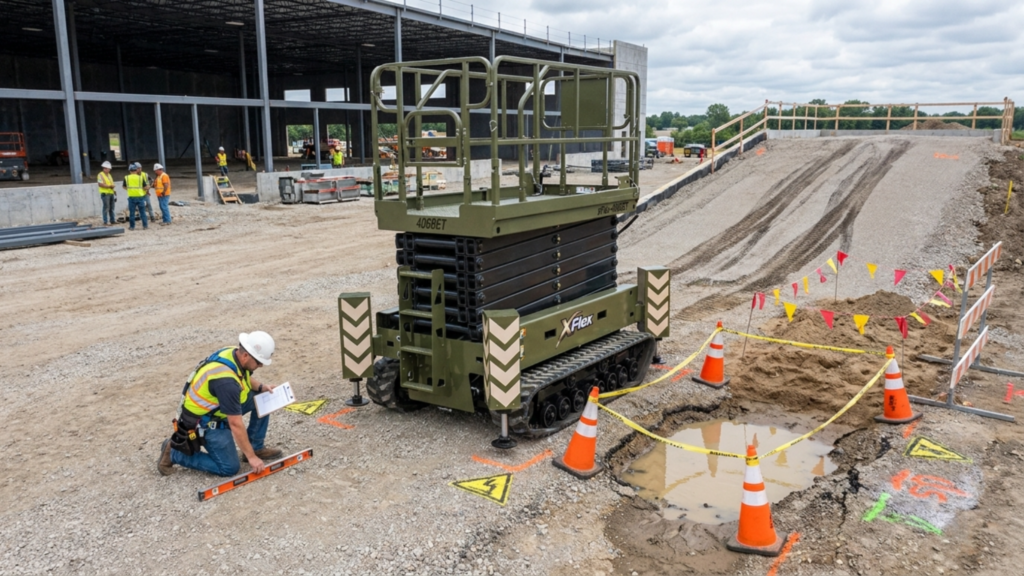
The problem occurs because the lift becomes unstable when driven on a slope, rolled into a hidden pothole, or parked on soft dirt that gives way under the weight of the machine. A surface that looks perfectly fine can easily hide a soft spot, a drop-off, or a small depression that throws the machine off balance. Once a raised lift begins to tip, there is very little anyone can do to stop the momentum.
To avoid this, start every job by walking to the work area before you ever bring the lift into the space. Look for hidden holes, soft ground, steep slopes, or unexpected drop-offs that could compromise stability. Only raise the platform when you are on flat, solid ground that is proven to support the full weight of the machine. Furthermore, never drive the lift while it is raised unless your operator manual specifically states that movement is safe for your particular model. A few minutes of careful inspection protects against one of the most catastrophic failures on any job site. If you have any doubt about the surface, do not raise the lift until you have fully confirmed it is safe to do so. Proper site assessment is your best defense against a tip-over.
Falling Off the Platform
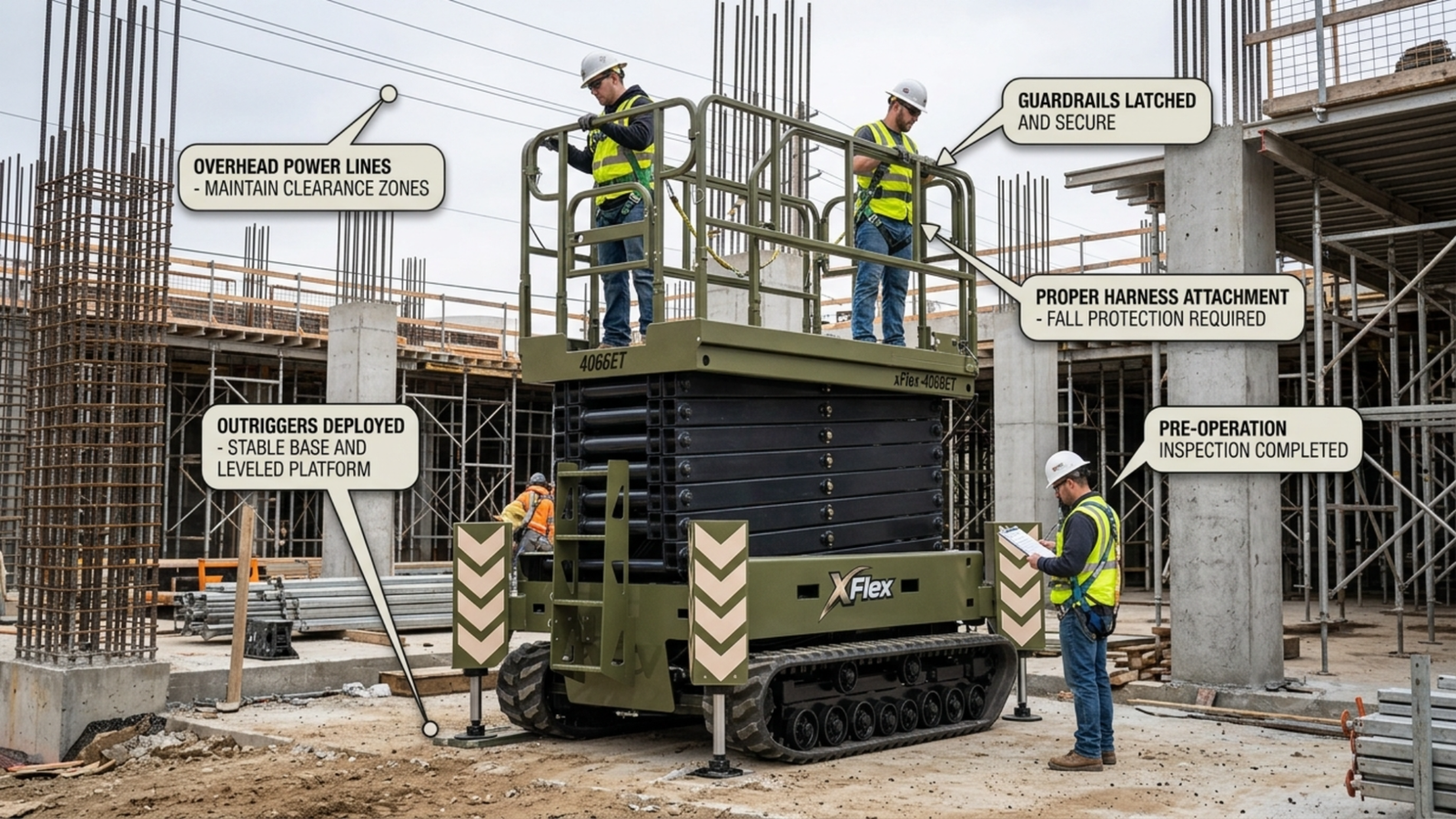
The guardrails on a scissor lift exist solely to keep workers safely inside the platform. When someone treats these rails as a stepping point or leans past them to reach a task, those safety protections effectively stop working. Falls from the platform remain a frequent and entirely preventable cause of serious injury.
This danger happens when a worker leans too far over the edge to reach a spot just out of range, or worse, climbs onto the metal guardrails to gain a little extra height. That shift in body weight is all it takes to slip and fall. The temptation to stretch for just one more inch is exactly what puts people on the ground and leads to long-term injuries.
To avoid these accidents, keep both feet flat on the platform floor at all times. If you cannot reach the work from a stable, standing position, you must reposition the lift instead of stretching for it. Never use ladders, buckets, boxes, or any other object inside the platform to gain extra height, as these items defeat the purpose of the guardrails and dramatically raise your fall risk. Always confirm that the safety gate is securely closed and latched before you even begin raising the platform. The rule is simple: the platform floor is the only safe place to stand, and the guardrails are a rigid barrier that should never be treated as a step. By keeping your feet on the floor and staying within the rails, you ensure that you remain secure regardless of your height.
Hitting Overhead Power Lines
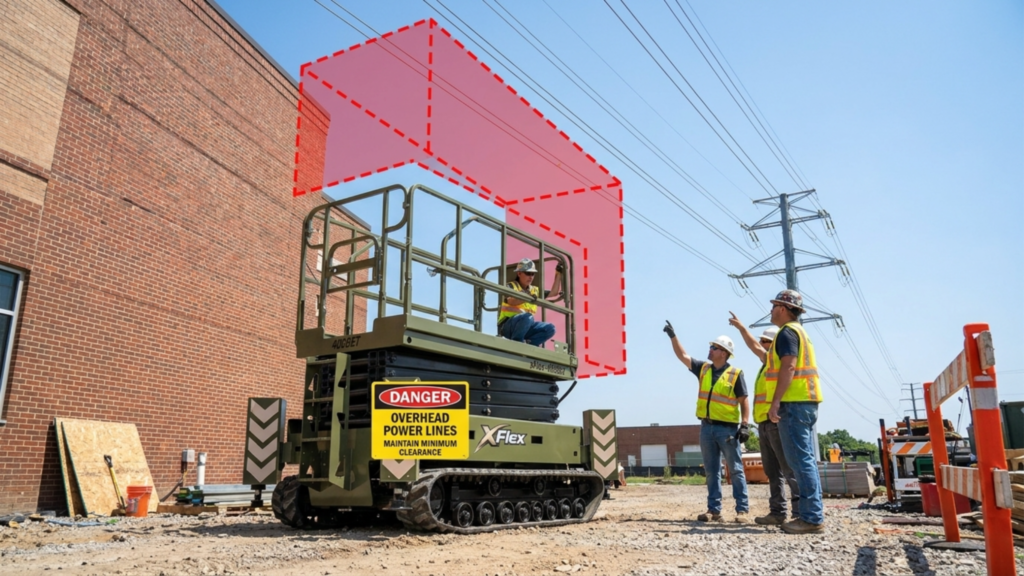
Electricity is an invisible hazard that gives no second chances. A scissor lift raises both the worker and their tools into a zone where overhead power lines may be waiting. Contact with a live line can cause severe, life-altering, or even deadly injuries in a matter of seconds.
The accident typically happens because the lift or a worker’s tools get too close to live electrical wires, causing a massive surge of current. Electricity can even arc across a gap without direct physical contact, so simply getting too close to a line is dangerous. Workers who are intently focused on the task in front of them often completely forget to check what is hovering overhead.
To avoid this, always look up before you raise the platform, and carefully scan the full path of your work for any hidden wires. Treat every single wire you see as if it is alive and energized, even if you firmly believe it is dead. Follow the strict, non-negotiable rule of keeping the machine, the platform, and all your tools at least 10 feet away from any power line. If your work brings you closer than that distance, you must stop immediately and have the line de-energized or shielded by the utility company before you proceed. Power lines demand absolute respect and distance. The 10-foot rule is your primary margin of safety, and you should never compromise on it. Vigilance is the only way to remain safe.
Getting Pinned Against the Ceiling
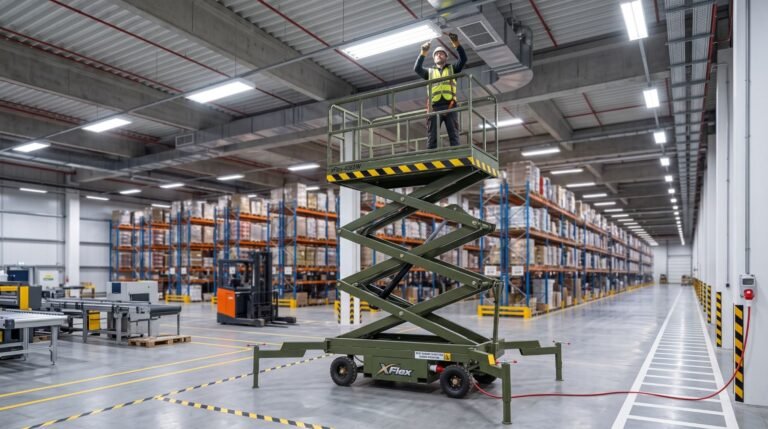
Indoor work brings a specific hazard that is easy to overlook: the structure directly overhead. Beams, pipes, ductwork, and low ceilings can trap an operator who is not watching where the platform is heading. Crushing and pinning injuries happen very fast and almost always catch the operator by complete surprise.
The hazard occurs when the operator raises or drives the lift and gets trapped between the machine control panel and an overhead beam, pipe, or ceiling. Because the operator’s attention is often directed toward the work rather than the space above their head, the platform can press them into an obstacle before they realize what is happening. This can lead to serious chest or limb injuries.
To avoid this, always look in the direction you are moving, and that includes looking up whenever you raise the platform. Move the machine slowly and deliberately when working in tight indoor spaces, which gives you plenty of time to react to anything overhead. Keep your entire body completely inside the guardrails so no part of you extends into the path of a beam or pipe. Awareness of your surroundings is everything when you are working indoors. Slow, controlled movement provides the precious time you need to stop before an obstacle becomes a dangerous trap. By constantly scanning the overhead space, you ensure that you are always in control of your environment.
Getting Bumped by Other Vehicles
A scissor lift does not operate in isolation. On a busy job site, forklifts, trucks, and other heavy machines share the same floor space, and the base of an elevated lift sits directly in their path. A collision at ground level can easily topple a lift with a worker high above.
This happens when a forklift, delivery truck, or other machine accidentally crashes into the bottom of the scissor lift while someone is working up in the air. A driver focused on a different part of the site may never see the base of the lift until it is too late, and even a minor, glancing hit can destabilize an elevated platform enough to cause a disaster.
To avoid this, set up a clear, protected safe zone around the base of the lift before anyone goes up. Use bright orange cones, warning tape, and highly visible signs to mark the area and force ground traffic to keep its distance. The barrier should be obvious enough that no driver can possibly mistake it. Where traffic is heavy, assign a dedicated spotter to watch the area or reroute vehicles entirely so they never pass near the lift. Protecting the base of the machine is the best way to protect the worker at the top. A well-marked safe zone keeps ground traffic where it belongs and ensures that your entire crew remains secure during the workday.
Conclusion
The most common scissor lift accidents share one important thing in common: they are entirely preventable. Tip-overs result from ignoring unstable ground, falls happen because of leaning or climbing, electrocutions occur from getting too close to power lines, pinning injuries are caused by rushing under overhead obstacles, and collisions stem from leaving ground traffic unprotected. Each of these hazards has a clear, proven way to avoid it, and none of them require anything more than constant attention and disciplined habits.
Safety is not just about the equipment itself; it is about the mindset you bring to the job every single day. By taking the time to inspect your site, respecting the boundaries of the platform, maintaining a safe distance from electricity, being aware of overhead structures, and clearly marking your work zone, you eliminate the risks that lead to tragedy. These safety measures are simple, but they are incredibly effective when applied consistently. Your goal is to return home at the end of every shift exactly the same way you arrived. By staying disciplined and refusing to take shortcuts, you protect yourself, your coworkers, and the overall productivity of your project. Remember, the safest machine on any job site is one operated by a professional who values awareness above all else.