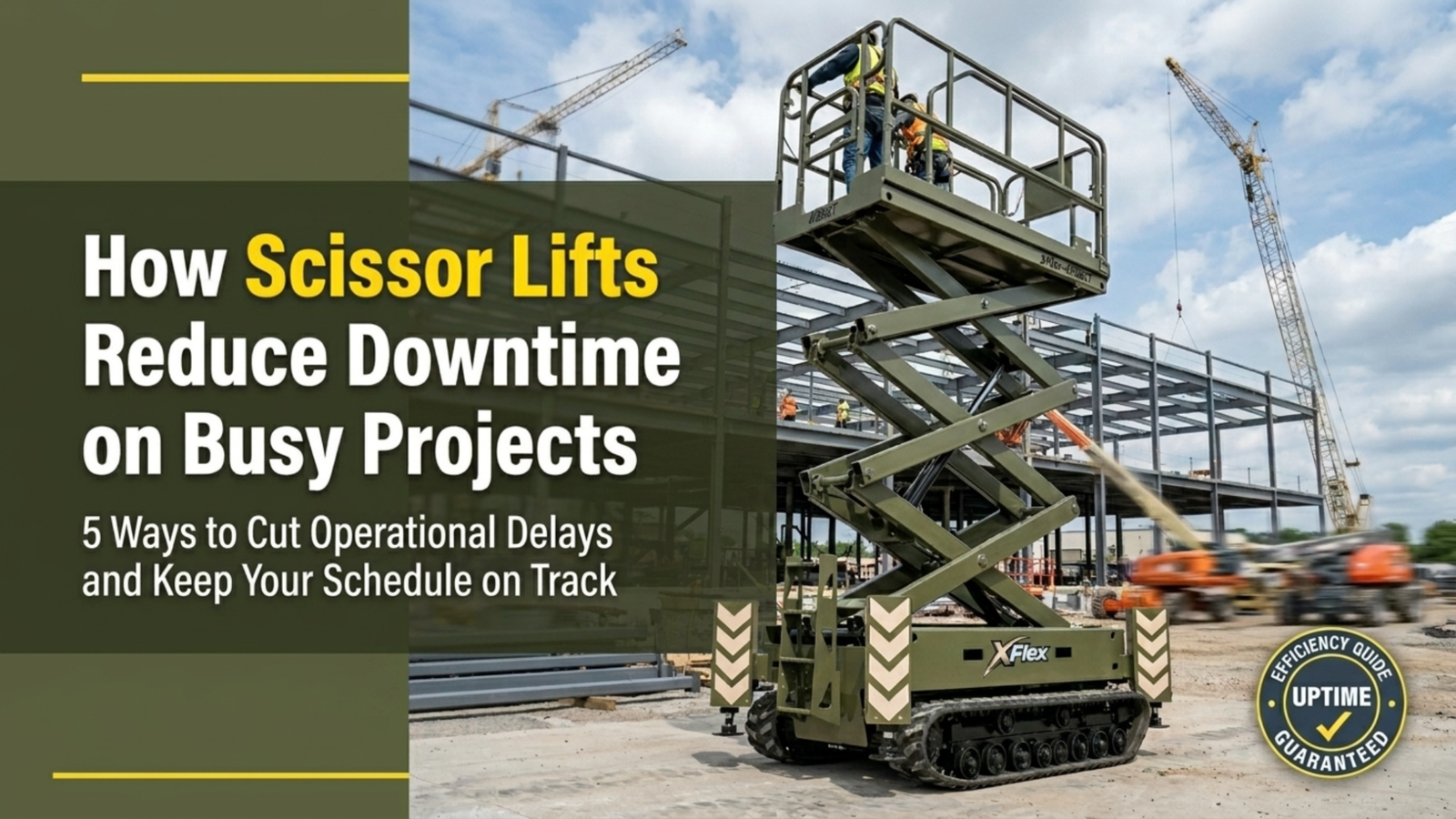
On a busy construction or maintenance site, time is the resource you can never get back. Every minute spent setting up scaffolding, repositioning ladders, or waiting for tools to reach a working platform is a minute pulled away from the actual job.
Scissor lifts solve this problem by giving crews fast, stable, and flexible access to elevated work areas without the delays that slow traditional methods down. They keep workers moving, materials close, and tasks flowing from one to the next with far fewer interruptions.
The five sections below break down exactly how scissor lifts cut operational downtime and keep your project on schedule, covering vertical access, payload capacity, mobility, worker safety, and multi-trade coordination.
Enhanced Vertical Access Efficiency
The single biggest way scissor lifts reduce downtime is by transforming how quickly workers reach elevated work areas. Traditional access methods come with built-in delays that quietly drain hours from every shift. Scaffolding must be assembled piece by piece, inspected, and later torn down, while ladders require constant repositioning and careful footing checks that interrupt the rhythm of the work.
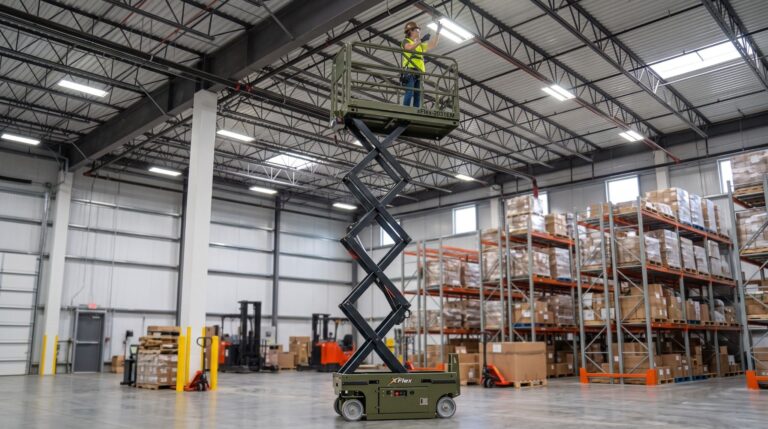
A scissor lift removes nearly all of that overhead. An operator steps onto the platform, raises it to the exact working height in seconds, and gets straight to the task without pausing to build or rebuild a structure. When the job calls for a different height, the platform adjusts smoothly while the worker stays in place, eliminating the repeated climbing up and down that fragments a ladder-based workflow.
This instant adjustability matters enormously on jobs that span a range of elevations, such as installing ductwork, running conduit, or finishing a tall wall, where small changes in height happen constantly throughout the day. Instead of stopping to move a ladder every few feet, the crew simply repositions the platform and continues. The time saved adds up faster than most managers expect, because the delays being eliminated are small but relentless. Consider where the hours actually disappear on traditional setups:
- Assembly and teardown of scaffolding before and after the work even begins
- Repositioning ladders every time a task shifts a short distance sideways or upward
- Climbing down and back up to reach a slightly different elevation
By compressing all of these recurring delays into a quick platform adjustment, scissor lifts let teams pour their energy directly into productive work rather than the constant logistics of simply getting into position to start.
Increased Payload Capacity for Tools and Materials
A scissor lift does more than carry a person to a height; it carries the entire workstation up with them, and that capacity is one of its most powerful downtime-reducing features. Spacious platforms are engineered to support multiple workers along with the tools, fasteners, fixtures, and materials they need to complete a task without interruption. This eliminates one of the most frustrating and common sources of lost time on elevated jobs: the back-and-forth trips for forgotten or additional supplies.
With a ladder, a worker who realizes they left a drill bit or ran short on conduit below has no choice but to climb all the way down, gather what they need, and climb back up, breaking concentration and stalling progress each time. Scaffolding improves on this slightly but still relies on someone hoisting materials up or passing them hand to hand, which ties up labor and creates waiting periods that ripple through the crew. A scissor lift platform changes the equation entirely by letting the team stage everything they need in a single trip. The work continues uninterrupted because the materials are already there, within arm’s reach, ready when the moment calls for them.
This continuous workflow is especially valuable on repetitive tasks where momentum drives output, such as installing lighting across a ceiling grid or mounting a long run of brackets. The generous load capacity also supports heavier equipment that would be unsafe or impossible to carry up a ladder, opening the door to using more capable tools at height. When workers spend their time working instead of fetching, the project moves measurably faster and the downtime caused by constant resupply trips simply disappears.
Improved On-Site Mobility
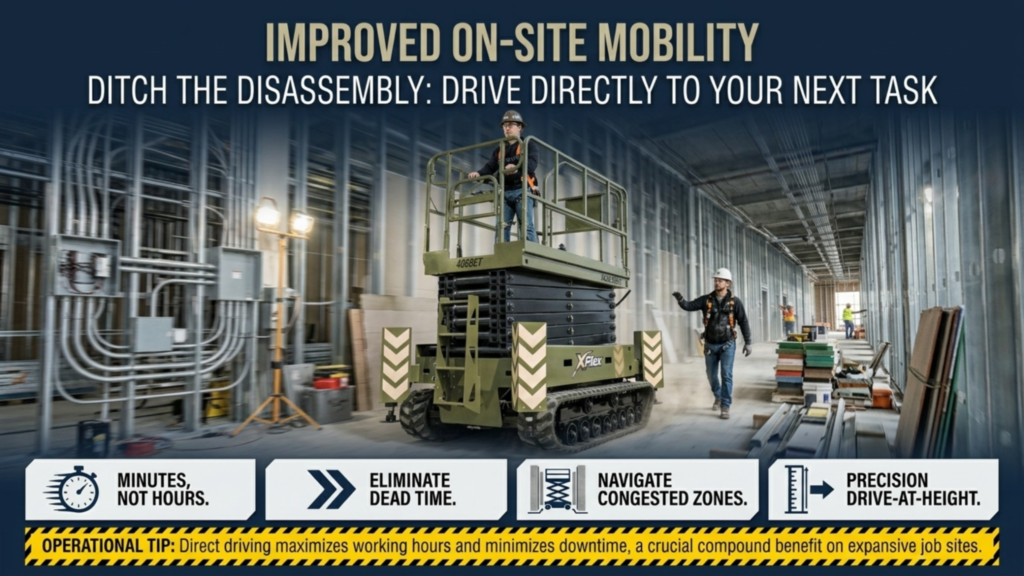
The ability to move a scissor lift quickly from one work area to the next is a quiet but significant contributor to reduced downtime. Modern machines are built with mobility in mind, allowing an operator to drive the unit directly across the work zone to the next location without any disassembly. This stands in sharp contrast to scaffolding, which must be taken apart, transported, and reassembled every single time the work shifts to a new area, consuming labor and creating long gaps between tasks.
With a scissor lift, the transition between work points becomes nearly seamless. As soon as one section of a job wraps up, the crew lowers the platform, drives to the next spot, and raises it again, ready to resume in moments rather than hours. This rapid redeployment keeps the project advancing at a steady pace and prevents the dead time that builds up whenever access equipment has to be relocated the hard way. The advantage compounds on large sites where work naturally progresses across a wide footprint, such as warehouses, parking structures, or sprawling commercial interiors, where crews may need to reposition many times in a single day.
Many machines also offer compact footprints and tight turning capabilities that let them navigate doorways, aisles, and congested areas without difficulty, reaching spots that bulky scaffolding could never serve efficiently. Some units are designed to be driven at full or partial height, letting operators make small position adjustments without fully lowering and raising the platform between closely spaced tasks. Every one of these features shortens the gap between finishing one job and starting the next, and shorter transitions translate directly into more productive hours and a project that stays comfortably on schedule.
Boosted Worker Safety and Reduced Fatigue
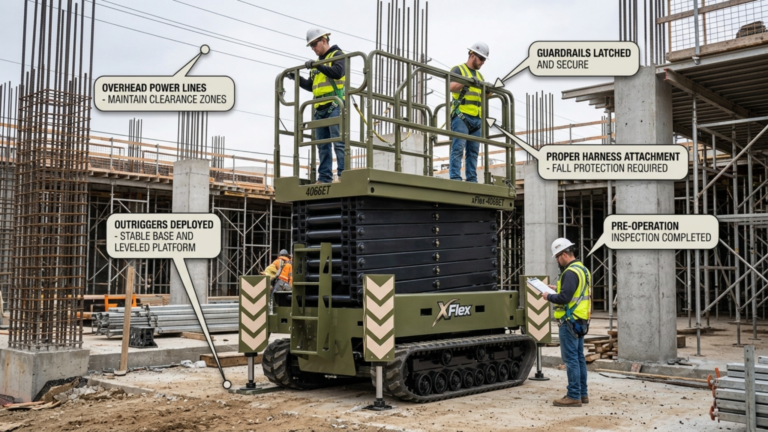
Worker safety and physical comfort have a direct, measurable effect on downtime, and this is an area where scissor lifts deliver real returns. A stable, fully enclosed platform with guardrails gives workers a secure place to stand and work, eliminating the precarious balancing and awkward reaching that ladders so often demand. When a person feels secure, they work with confidence and focus rather than spending mental energy managing their footing or worrying about a fall. That confidence shows up as steadier hands, better-quality work, and fewer hesitations that slow a task down.
Beyond the immediate safety benefit, the ergonomic advantages of working from a level, spacious platform reduce the physical toll that builds over a long shift. Climbing ladders repeatedly, holding strained positions, and supporting heavy tools while balancing on a narrow rung all wear a body down quickly, and a fatigued worker is both slower and more prone to mistakes. By keeping crews at a comfortable working height with room to position themselves naturally, scissor lifts help maintain consistent productivity from the first hour of the shift to the last.
The most important downtime savings, however, come from preventing the incidents that bring work to a complete stop. Falls and overexertion injuries are among the most common and serious hazards on elevated jobs, and a single accident can halt an entire crew, trigger investigations, and sideline a skilled worker for weeks. A few of the safety advantages that keep projects moving include:
- Guarded platforms that dramatically lower the risk of falls from height
- Stable footing that removes the balance strain of ladder work
- Reduced repetitive climbing that prevents the fatigue leading to errors and injury
Healthy, confident workers stay on the job and keep production steady, which is exactly what a tight schedule demands.
Streamlined Multi-Trade Coordination
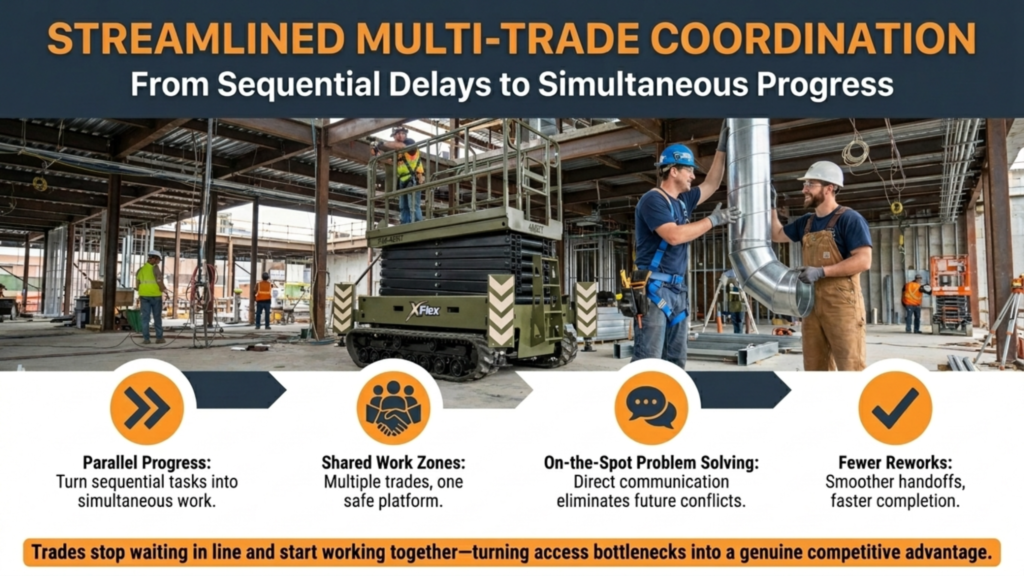
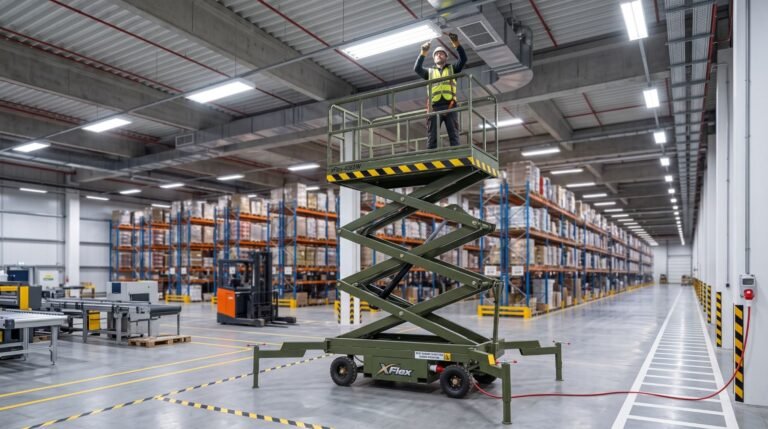
On complex projects, downtime frequently stems not from any single task but from trades waiting on one another to clear shared access points, and large scissor lift platforms offer a powerful solution to this bottleneck. The generous deck space on many machines allows several workers from different specialties to occupy the same vertical zone at the same time, transforming what would be a sequential process into a parallel one.
Picture a stretch of ceiling where electricians need to run wiring, HVAC technicians need to position ductwork, and painters need to finish the surrounding surfaces. With a single ladder or a narrow access point, these trades would be forced to take turns, each one idle while another occupies the limited space, and the resulting waiting periods stack up into serious schedule slippage. A spacious scissor lift platform lets these crews share the zone and progress together, so the electrical, mechanical, and finishing work advances side by side rather than one after another. This collaborative capacity does more than save time; it improves coordination, because workers from different trades can see and communicate with one another directly while the work is happening, resolving conflicts on the spot instead of discovering them later.
The result is fewer reworks, smoother handoffs, and a steadier overall pace. On fast-tracked projects where multiple trades must compress their schedules into overlapping windows, this shared-access capability becomes a genuine competitive advantage. It removes the artificial sequencing that limited access forces onto a crew and replaces it with true simultaneous progress. When trades stop waiting in line for their turn at height and start working together in the same space, the project absorbs far fewer delays and reaches completion faster.
Conclusion
Scissor lifts reduce downtime by attacking every angle a busy project faces. They give crews fast, adjustable vertical access that eliminates the constant setup and teardown of scaffolding and ladders. Their spacious platforms carry workers, tools, and materials up together, ending the wasted trips that break momentum. Built-in mobility lets teams roll from one work area to the next in moments rather than hours, while stable, guarded platforms keep workers safe, comfortable, and productive through every shift. On top of that, generous deck space allows multiple trades to work side by side instead of waiting in line for limited access. Each of these advantages saves time in small, steady increments that add up to real schedule gains over the life of a project. When you choose the right scissor lift for the job and use it well, you remove the hidden delays that quietly erode productivity—keeping your crews moving, your timeline intact, and your project running smoothly from start to finish.