
A paving crew lays a fresh asphalt mat on a parking lot, and the roller operator, eager to finish before the mix cools, makes two quick passes and calls the section done. A week later, cracks spiders across the surface, ruts form where cars park, and the client is on the phone demanding to know why a brand-new lot is already failing. The mix was right, the roller was capable, and the base was sound. The compaction simply stopped short of the density the material needed, and those two rushed passes cost far more to fix than the extra rolling would have cost to do. That failure is exactly why knowing how many passes an area really needs matters before the roller ever starts.
Getting compaction right comes down to matching your pass count to the material, the lift, and the machine, then confirming the result rather than guessing at it. Too few passes leave the surface weak and prone to failure, while too many waste time and can actually damage what you’ve built. This guide walks through why pass count matters, the factors that decide how many passes you need, typical ranges by material, how to test for density, the signs of over-compaction, and the on-site habits that keep every section right. Here’s what to know before you start rolling.
Why the Number of Passes Decides the Outcome
Compaction is what turns loose material into a solid, load-bearing surface, and the pass count is how you get there. Each pass of the roller presses the particles closer together, squeezing out air and water until the material reaches the density its design calls for. Stop too early and the surface stays porous and weak; keep going past the target and you risk crushing the very structure you’re building.
Density is the goal every pass works toward, and it’s measured against a target the project specifies. Reaching that target means the surface can carry traffic, resist water, and hold its shape for years, while falling short invites rutting, cracking, potholes, and premature failure. The pass count isn’t about rolling until it looks flat; it’s about rolling until the material hits the number the job demands.
Getting it wrong costs money in both directions. Under-compaction leads to repairs, callbacks, and a surface that fails long before its time, while over-compaction wastes labor, fuel, and machine hours and can fracture aggregate or shove the mix around. Key takeaway: The right pass count delivers the density that makes a surface last, so treat it as a target to hit precisely rather than a task to rush through or overdo.
Factors That Decide How Many Passes You Need
Several variables shape the pass count, and no single number fits every job, so read the conditions before you set your plan. The same roller might need three passes on one material and eight on another, all depending on what you’re compacting and how you’re set up. Understanding these factors keeps you from guessing at a number that only fits by accident.
Material type leads the list, since different materials compact at different rates. Asphalt reaches density quickly and holds heat-sensitive timing, granular fills like gravel and sand compact steadily, and cohesive soils like clay resist compaction and demand more passes to reach the same result. Lift thickness matters just as much, because a thick lift traps compaction energy near the top and needs more passes, or a lighter lift, to compact all the way down.
Roller weight and vibration round out the equation. A heavier machine delivers more compaction force per pass, so it reaches density in fewer passes than a lighter one, and turning on the drum’s vibration multiplies that force dramatically, cutting the pass count further on suitable material. Matching amplitude and frequency to your lift depth means deep bases get strong vibration while thin finish layers get gentle static rolling. What this means: pass count is never a fixed number, so weigh your material, lift thickness, roller weight, and vibration settings together to arrive at the right count for the section in front of you.
Typical Pass Count Ranges by Material
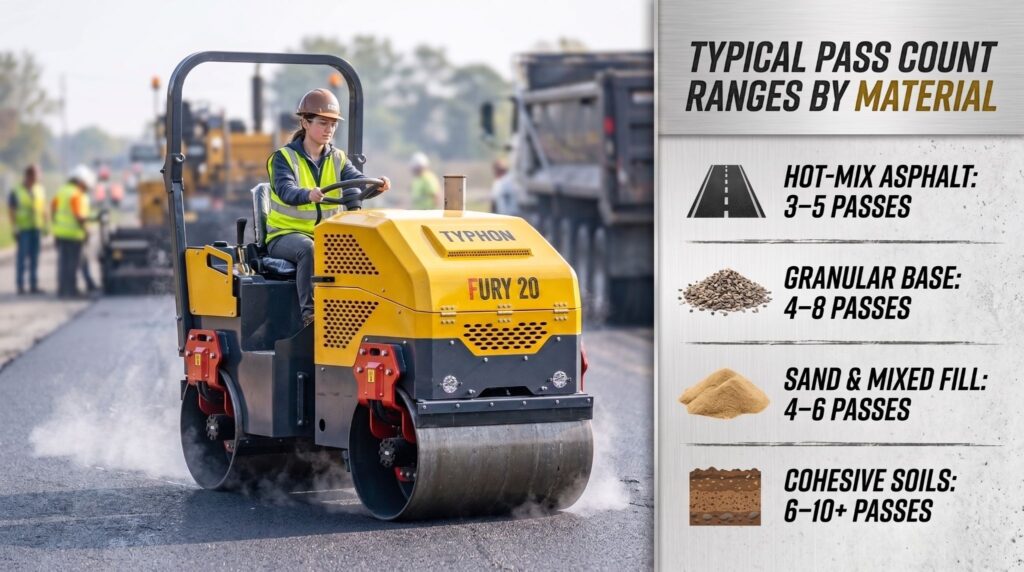
Numbers give you a starting point, so knowing the common ranges helps you plan a section before you confirm it with testing. These figures assume a properly sized roller and appropriate lift thickness, and they shift with machine weight and vibration, but they frame what to expect. Here’s a practical look at where most materials land:
- Hot-mix asphalt: Roughly 3 to 5 passes for most mats, working fast while the mix stays hot, with the exact count set by mat thickness, mix design, and temperature.
- Granular base (gravel, crushed stone): About 4 to 8 passes, since these compact steadily but need enough coverage to lock the aggregate together.
- Sand and mixed fill: Around 4 to 6 passes with vibration, which settles the loose particles into a dense, stable layer.
- Cohesive soils (clay, silty clay): Often 6 to 10 passes or more, because these resist compaction and usually call for a padfoot drum that kneads below the surface.
Treat these ranges as a guide rather than a promise, since local conditions, moisture content, and your specific machine all move the number. Starting near the middle of a range and testing your way to the target beats assuming any fixed count will hold across every job.
Key takeaway: Use these ranges to plan a section and set your rolling pattern, but confirm the actual pass count with density testing rather than trusting the number alone.
How to Confirm You’ve Reached the Target Density
Testing is what turns a guess into a certainty, so verify density rather than eyeballing the surface and hoping. Watching how the material behaves under the roller gives you early clues, but a real measurement is the only way to know if a section meets the project spec. Skipping the check is exactly how a surface that looks finished fails months later.
Field methods range from quick to precise. A nuclear density gauge reads compaction fast and non-destructively, making it the go-to on many jobs, while a sand cone test measures density directly and serves as a reliable reference. Watching the roller itself tells you plenty too, since the material stops visibly deflecting once it nears refusal, meaning extra passes no longer increase density.
Test proof-rolling offers a practical field check when instruments aren’t handy. Making a pass and watching for movement, rutting, or pumping under the drum reveals whether the layer is stable, and a section that stops moving has likely reached working density. What this means: confirm density with a proper test whenever the spec demands it, and read the material’s behavior under the roller as your on-the-spot signal that you’re closing in on the target.
Recognizing When You’ve Compacted Too Much
Over-compaction is one of the most common road roller asphalt compaction mistakes, yet many operators overlook it. More passes stop improving density once the material reaches refusal, and continuing beyond that wastes fuel, increases machine wear, and can begin to damage the finished surface.
Watch for signs that additional rolling is no longer improving compaction, and avoid making unnecessary passes. Knowing when to stop is just as important as knowing when to start.
Aggregate fracture is one clear warning on granular and asphalt work. Rolling long past the required density can crush and break stone particles, weakening the interlock that gives the layer its strength. Instead of improving stability, excessive compaction can reduce performance and create surface problems.
Cracking and displacement signal the same issue. Over-rolled asphalt can crack under the drum or shift sideways, creating ripples and surface defects. In certain soils, continued vibration beyond the optimum point can even cause decompaction, loosening the layer and undoing the density already achieved.
Key takeaway: Avoiding over-compaction is one of the best ways to prevent common road roller asphalt compaction mistakes. Stop rolling once the material reaches the target density to protect the surface, maintain strength, and complete the job efficiently.
On-Site Habits That Keep Every Section Right
Consistency separates a crew that hits density every time from one that gambles section by section, and a few habits make it routine. Building these into your rolling process means every part of the surface gets the same treatment, so no weak spot hides between the passes you counted and the ones you skipped. Discipline here pays back on a surface that lasts.
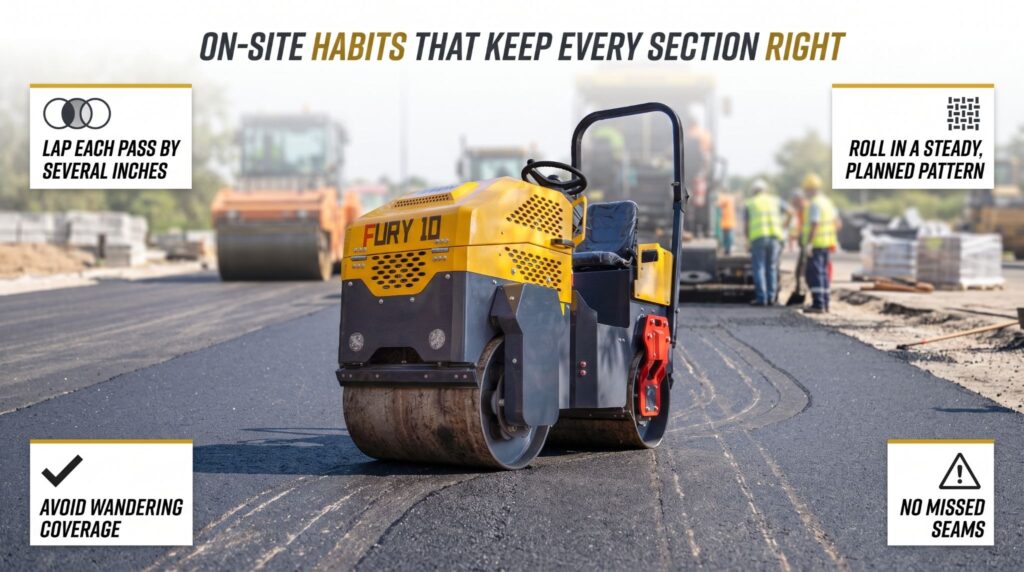
Overlapping your passes keeps coverage even across the full width. Lapping each pass over the previous one by several inches ensures no strip gets fewer passes than its neighbors, since a missed overlap leaves a soft seam that fails first. Rolling in a steady, planned pattern, rather than wandering across the mat, guarantees every square foot receives the count you intend.
Timing and moisture round out the habits that matter. Asphalt demands rolling while the mix stays within its compaction temperature window, so working promptly before it cools is non-negotiable, and soils compact best at their optimum moisture content, which means checking that the material is neither too wet nor too dry. What this means: count your passes, overlap every one, hold a consistent pattern, and respect the temperature and moisture that let the material reach density, and every section comes out as solid as the last.
Conclusion
Answering how often a road roller should pass over the same area comes down to matching your pass count to the material, the lift, and the machine, then confirming the result with a real measurement. Start by recognizing that pass count exists to reach a target density, then weigh the factors that shape it: material type, lift thickness, roller weight, and vibration settings all move the number up or down. Use the typical ranges, roughly 3 to 5 passes for asphalt, 4 to 8 for granular base, and 6 to 10 or more for cohesive soils, as a starting point, and verify density with a gauge or a field test rather than trusting the count alone. Stop once the material reaches refusal, since over-rolling cracks aggregate and can undo your work, and keep every section consistent by overlapping passes, holding a steady pattern, and respecting temperature and moisture. Get the pass count right, and you build a surface that carries its load and holds its shape for years. When you’re ready to put a dependable road roller matched to your job to work, reach out to a trusted equipment specialist who can pair a reliable machine with the results your projects depend on.
Frequently Asked Questions
How many passes does a road roller need?
It depends on the material, the lift thickness, and the roller. As a general guide, hot-mix asphalt usually needs about 3 to 5 passes, granular base around 4 to 8, and cohesive soils like clay 6 to 10 or more. A heavier roller and vibration reduce the count, while thicker lifts and stubborn soils raise it. Treat these ranges as a starting point and confirm the result with density testing rather than trusting a fixed number.
How do I know when compaction is complete?
The surest way is to measure density with a nuclear gauge or a sand cone test against your project’s target. On site, you can also read the material itself: once it stops visibly deflecting under the drum and no longer moves, ruts, or pumps, it has likely reached refusal and won’t gain density from more passes. When the spec calls for a specific density, always confirm it with a proper test.
Can you over-compact with a road roller?
Yes, and it causes real damage. Rolling past the point of refusal crushes and fractures aggregate, weakening the interlock that gives a layer its strength, and it can crack or displace asphalt into ripples. On some soils, continued vibration actually loosens the material back up, undoing the density you achieved. Stop rolling once the material reaches its target density, since extra passes waste time and fuel while harming the surface.