
A scissor lift looks straightforward to operate, and that is exactly what makes it dangerous. The simplicity of the controls can lull operators into treating the machine casually, right up until a tip-over, a fall, or a contact incident proves otherwise. Most scissor lift accidents are not freak occurrences. They trace back to a handful of predictable, preventable errors that experienced crews and rental customers make again and again.
This guide is written for equipment operators, site supervisors, safety managers, and the rental customers who put these machines to work every day. Below, we walk through the five most common and costly scissor lift mistakes, explain how each one leads to real harm, and give you practical guidance for avoiding them.
Here is what you will take away:
- The errors that most often cause scissor lift injuries and equipment damage
- Why each mistake happens and what it actually costs
- Clear, actionable steps to keep your crew and your jobsite safe

Mistake 1: Exceeding the Rated Weight Capacity
The single most fundamental rule of scissor lift safety is also one of the most frequently broken: never exceed the machine’s rated capacity. Every scissor lift carries a specified limit for the total weight it can support on the platform, including the operators, their tools, and any materials they bring up with them. Overloading the platform compromises the stability the machine was engineered to maintain, and the consequences range from poor performance to a catastrophic tip-over.
The mistake usually happens innocently. A crew loads the platform with workers and then adds heavy materials, conduit, fixtures, or a toolbox, without ever adding up the combined weight against the machine’s limit. On a busy jobsite, it is easy to assume that if everything fits on the platform, the lift can handle it. That assumption is exactly where the danger lives, because a scissor lift does not warn you in any obvious way that it is approaching its limit until stability is already compromised.
Avoiding this error starts with knowing the numbers. Check the capacity plate on the machine and confirm the rated platform capacity before any work begins. Many scissor lifts also specify a separate, lower capacity for an extended platform, so account for that if your machine has a roll-out deck. Add up the weight of every operator, every tool, and all materials honestly, and build in a margin rather than working right at the edge of the rating. When a job genuinely requires more capacity than your machine offers, the answer is a larger lift, not a creative interpretation of the limit.
Key takeaway: Always total the combined weight of people, tools, and materials, then confirm it stays comfortably within the rated capacity before you elevate.

Mistake 2: Operating on Unstable or Uneven Ground
Scissor lifts are designed to elevate workers straight up from a stable, level base, and that base is everything. When the ground beneath the machine is soft, sloped, uneven, or compromised, the entire foundation of the lift’s stability disappears. Operating on unstable ground is a leading cause of scissor lift tip-overs, and the risk grows dramatically as the platform rises because even a slight base angle translates into a significant lean at full height.
The trouble shows up in a variety of forms. An operator positions the machine on a patch of gravel that gives way under the wheels, or on asphalt softened by summer heat, or across a slope that looks gentle from the cab. Indoor operators run into floor drains, expansion joints, dock edges, and uneven transitions that can shift the machine just enough to matter at height. Outdoor crews face mud, loose fill, hidden voids, and ground that shifts after rain. In each case, the operator trusted a surface that could not actually support the loaded machine safely.
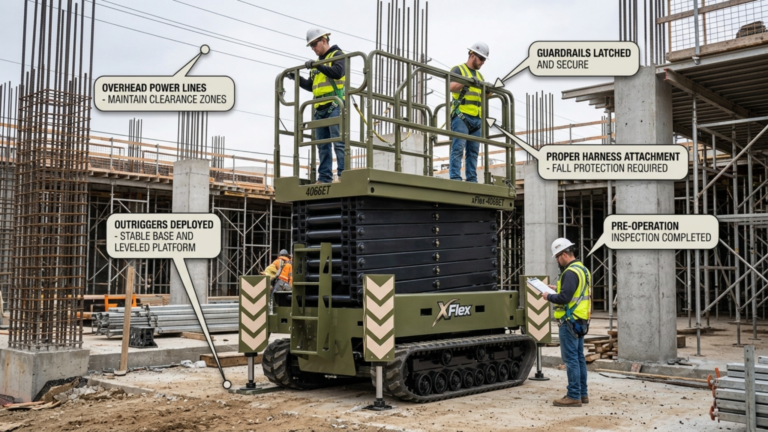
Preventing this comes down to assessing the ground before you ever raise the platform. Walk the area, confirm the surface is firm and level, and watch for slopes that exceed the machine’s rated limits. Use the manufacturer’s specifications as your guide rather than your own judgment about what “looks level enough.” For outdoor and rough terrain work, choose a machine built for those conditions, with the four-wheel drive, ground clearance, and leveling outriggers that engineering provides. Where a surface is questionable, stabilize it or relocate the machine rather than gambling on it holding. A scissor lift that is solid at ground level stays solid at height, and that is the entire point.
Key takeaway: Confirm the surface is firm, level, and within slope limits before elevating, and never trust ground that simply looks good enough.

Mistake 3: Skipping the Pre-Use Inspection
A pre-use inspection takes only a few minutes, yet skipping it ranks among the most common and consequential scissor lift mistakes operators make. Pressed for time at the start of a shift, crews often climb aboard and go to work without checking the machine first. That shortcut means defects go undetected until they fail, and a hydraulic leak, a worn control, or a damaged guardrail discovered at height is a far worse problem than one caught on the ground.
The danger here is that scissor lifts hide many of their problems until the moment they matter most. A brake that does not hold, a control that sticks, a tire low on pressure, or a structural crack in the scissor assembly may give no warning during a casual glance. The pre-use inspection exists precisely to surface these issues before the machine carries anyone into the air, where a malfunction leaves the operator with few good options.
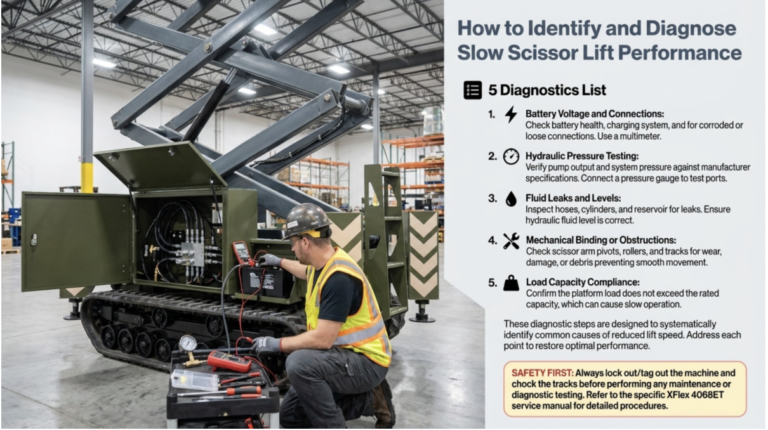
Build the inspection into the daily routine so it becomes automatic rather than optional. Before each shift, check the fluid levels and look underneath for leaks, confirm the tires or tracks are in good condition, and verify that the brakes hold firmly. Test the controls from the ground station and the platform to confirm they respond smoothly, and check that the emergency lowering function works. Examine the guardrails, gate, and platform for damage, and confirm that the horn, alarms, and any safety devices function correctly. Inspect the scissor mechanism itself for cracks, bent components, or worn pins. Any defect means the machine gets tagged out and reported, not pressed into service until the end of the day.
Key takeaway: A few minutes of pre-use inspection catches the failures that become emergencies at height, so make it a non-negotiable part of every shift.

Mistake 4: Misusing or Bypassing the Guardrail System
The guardrail system is the primary fall protection a scissor lift provides, and it only works when it is used as designed. Misusing the guardrails ranks among the most dangerous scissor lift mistakes precisely because it directly invites a fall, the very hazard the platform is built to prevent. This mistake takes several forms, and each one undermines the protection that keeps an elevated worker safe.
The most frequent version is reaching or leaning out beyond the guardrails to access a spot just out of range. Rather than lowering the platform and repositioning the machine, an operator stretches over the rail, shifting their center of gravity outside the protected zone and risking both a fall and a tip-over. Climbing or standing on the guardrails to gain a few extra feet of height is even more dangerous, removing the worker from the platform’s protection entirely. Leaving the access gate open or chained improperly, or stacking materials and ladders on the platform to extend reach, all defeat the system in the same way.
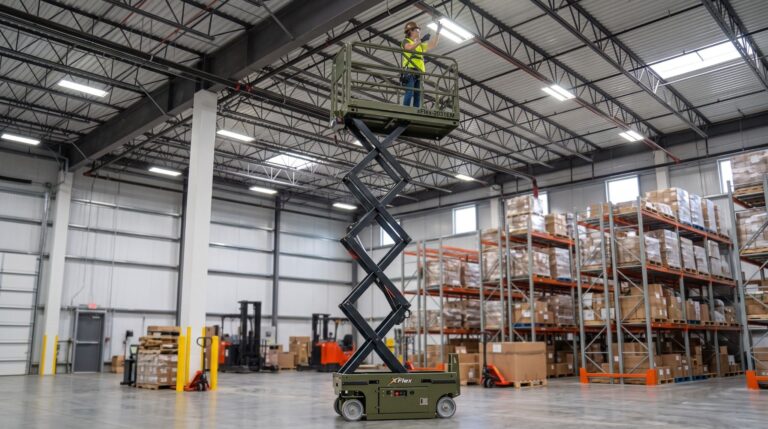
Using the guardrails correctly is simple in principle and demands discipline in practice. Keep both feet on the platform floor at all times, and never climb, stand, or sit on the rails. Always close and secure the access gate before raising the platform, and keep it closed throughout the work. When a task sits beyond comfortable reach, lower the lift and reposition it rather than leaning out. Where the work or local requirements call for it, wear the appropriate personal fall protection and anchor it only to the manufacturer-designated points. The guardrails protect you only when you stay inside them, so treat that boundary as absolute.
Key takeaway: Keep both feet on the deck, the gate secured, and your body inside the rails at all times, and reposition the machine rather than reaching beyond it.

Mistake 5: Ignoring Overhead Hazards and Wind Conditions
The final mistake involves everything happening above and around the platform, where operators focused on the work in front of them lose track of the larger environment. Ignoring overhead hazards and wind conditions causes serious contact incidents and tip-overs, particularly because a scissor lift raises a worker directly into the zone where these dangers live. Aerial lift safety depends on constant awareness of what surrounds the platform, not just what is on it.
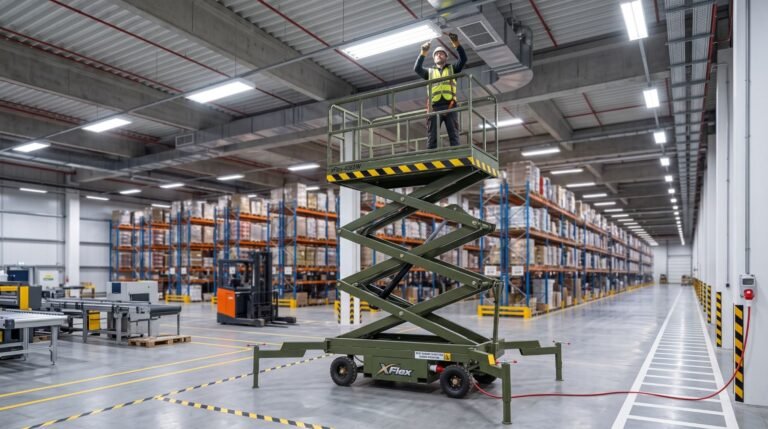
Overhead hazards are unforgiving. Power lines top the list, and contact with them is frequently fatal, so operators must identify energized lines before raising the platform and maintain the required clearance distance at all times. Beyond electrical hazards, low ceilings, structural beams, pipes, ductwork, door frames, and building features can crush or pin an operator who elevates without looking up. Indoors, the risk of striking overhead structures is constant in facilities packed with mechanical systems. The discipline is straightforward: always check what is above before you raise the platform, and watch the overhead clearance continuously as you reposition.
Wind introduces a hazard that many operators underestimate. A raised scissor lift platform acts like a sail, and wind that feels manageable at ground level exerts significant force at height. Every machine carries a maximum wind speed rating, and exceeding it risks a tip-over even on level ground. Carrying large, flat materials such as plywood or sheet panels on an elevated platform multiplies this effect dramatically, turning the load into a sail that catches gusts. Check the wind speed against the manufacturer’s rating before working at height outdoors, postpone elevated work when conditions exceed the limit, and never use a scissor lift in a thunderstorm or high wind. Respecting both the sky above and the air around the platform keeps a routine job from becoming a tragedy.
Key takeaway: Identify power lines and overhead obstructions before raising the platform, and never work at height when wind exceeds the machine’s rated limit.
Building a Culture That Prevents These Mistakes
Knowing the five mistakes is only the start. The operations with the strongest safety records turn this knowledge into consistent daily habits, supported by supervisors who model the standards they expect. That means proper training on the specific machine each operator runs, clear accountability for inspections and load limits, and a jobsite where reporting a near-miss or a tagged-out machine is treated as good practice rather than a problem.
Training matters most of all. Every operator should understand the machine’s capacity, stability requirements, fall protection, and environmental limits before working independently, and refresher training keeps those fundamentals sharp. When supervisors reinforce these scissor lift safety tips daily and respond to shortcuts immediately, the right behavior becomes the norm rather than the exception. A well-trained, attentive crew is the most reliable safeguard any operation has.
Conclusion
Scissor lift accidents are rarely the result of bad luck. They stem from five predictable errors: exceeding the rated capacity, operating on unstable ground, skipping the pre-use inspection, misusing the guardrails, and ignoring overhead hazards and wind. Each one is entirely preventable with awareness and discipline, and together they account for the majority of the serious incidents these machines cause.
Start today by reviewing your pre-use inspection process and confirming that every operator knows how to total platform weight against the machine’s rated capacity. Those two habits eliminate a large share of controllable risk on their own. From there, reinforce stable setup, correct guardrail use, and environmental awareness through regular training and consistent supervision. Put these scissor lift safety tips into practice, and you protect both your crew and your operation on every job that follows.